
Ready-to-Fund Resilience Toolkit
The Ready-to-Fund Resilience Toolkit was created through a partnership between the American Society of Adaptation Professionals (ASAP) and Climate Resilience Consulting (CRC) . The work was supported by a grant from the Climate Resilience Fund’s Coordination and Collaboration in the Resilience Ecosystem Program .
Learn more about the full Ready-to-Fund Resilience Project or the Funding and Finance Peer-Learning Group .
News and Analysis

Table of Contents
- News and Analysis
- About this Toolkit
- Introduction
- Funding and Finance 101
- Got Challenges? Find Solutions.
- 10 Characteristics of Ready-to-Fund-Projects
- Quick References
- Policy Incentives
- Risk Management Mechanisms
- Financing Mechanisms
- Discounting Alternatives
- U.S. Federal Resilience Funding Sources
- Characteristics of Potential Partners
- Glossary
- Acknowledgments
About this Toolkit
Is this toolkit for me?
This toolkit was developed for:
- Small- and-mid-sized local government practitioners working on resilience.
- Small- and-mid-sized local government department leads with power over, and a stake in, climate resilience funding and finance.
- Organizations and government bodies with the capacity and jurisdiction to support local government climate resilience funding and finance through policy, resources, technical assistance, partnerships, or process change.
We refer to this audience collectively as “local government leads and partners”.
What will this toolkit teach me?
What will this toolkit teach me?
This toolkit describes “how” local government leads and partners can design more fundable projects by pulling specific policy levers, seeking key partnerships, using innovative accounting practices, inverting power structures, and rethinking and redesigning internal processes. It will help local government leads and partners operate within current finance and policy systems to better prepare themselves and their communities for climate resilience funding and finance.
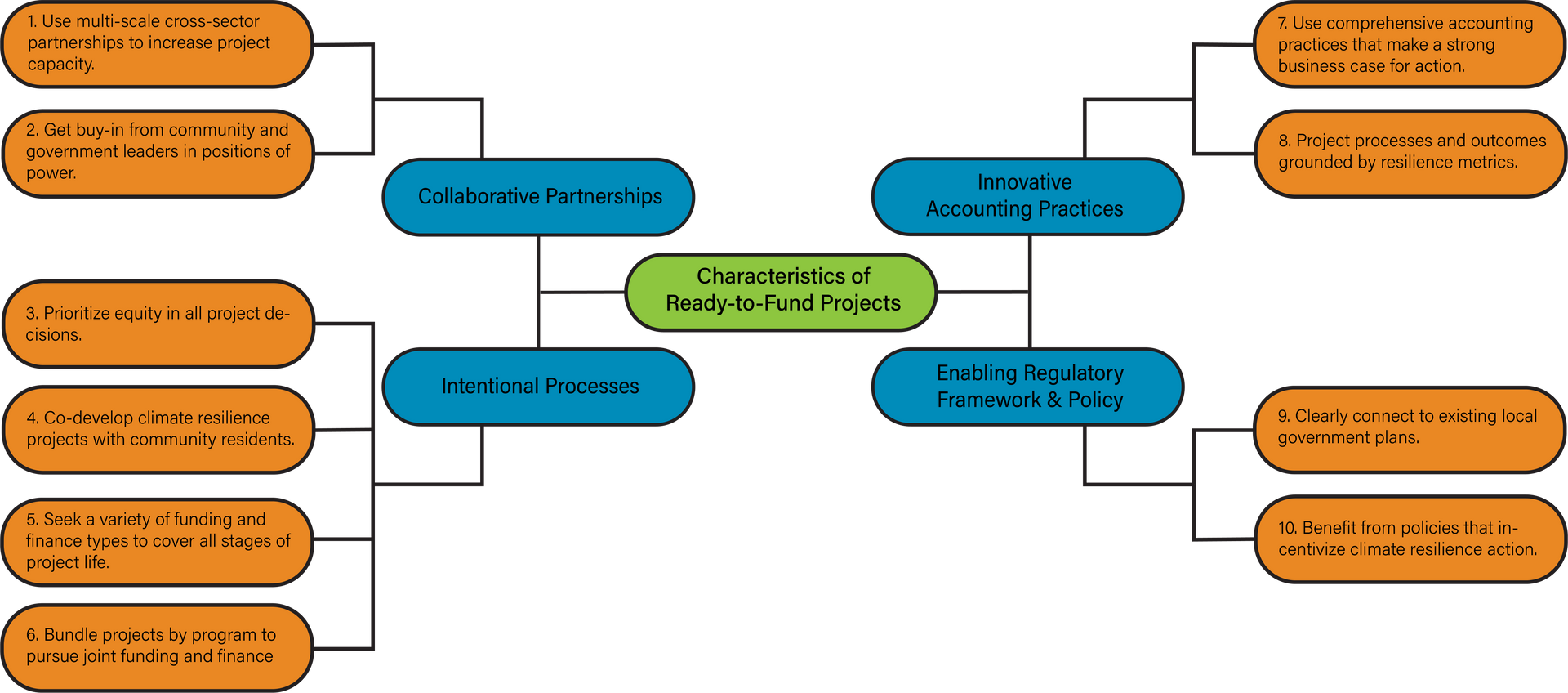
Projects that are ready to secure resilience funding and finance are those which benefit from collaborative partnerships, use intentional processes, use comprehensive accounting practices, and benefit from enabling regulatory and policy frameworks. This tool covers ten characteristics of ready-to-fund resilience projects.
What types of projects does this toolkit support?
This toolkit applies to a variety of types of resilience projects, from “traditional” grey infrastructure to green infrastructure and social infrastructure. It supports local government practitioners to:
- More effectively operate within the resilience funding and finance system.
- Better prepare themselves to receive funding and finance for climate resilience-building.
- Create equity through resilience funding and finance.
What CAN’T this toolkit do?
This toolkit can’t provide the full range of insight needed for local governments to succeed in funding transformative climate resilience projects.
Why Not?
Local governments experience many systemic barriers to centering equity and securing sufficient funding and finance for climate resilience investment. For instance, targeting resources to frontline communities may prove to be prohibitive politically. Funding applications may require design, planning, or code elements a local government does not possess the resources to acquire. Immediate and pressing community needs may take priority for limited government resources. Climate resilience projects interweave inextricably with local contexts. Therefore, funding them is not a standardized one-size-fits-all approach.
This toolkit can’t provide a roadmap to a single endpoint.
Why Not?
Resilience is not an end state. It is a process of ongoing monitoring, shifting, and realignment. Rather than offering a roadmap to a singular endpoint, this toolkit offers guidance to support local government practitioners to develop flexible and dynamic partnerships, policies, processes, and practices that create a positive funding and finance environment to support climate resilience.
Introduction
Momentum is rising for climate resilience-building. In 2020, the U.S. incurred 22 billion-dollar disasters and forecasts signal continually rising disaster costs, regardless of the scale of mitigation that occurs. [1] In tandem, deep social inequities and racial injustices inhibit otherwise capable communities from thriving. The obligation to mitigate damage and transform into a just and equitable society has triggered a movement to build more green, vibrant, and equitable local governments. While the unavoidable costs may be the primary drivers for action, the transformational opportunities and myriad community benefits that we can create provide deep motivation to continue this work.
Still, desires and plans for change often fall short of mobilizing action. Making the business case and securing climate resilience financing are the most common inhibiting factors. This guide can help increase climate resilience and create thriving, just, and equitable communities by securing funding and finance for the physical and social infrastructure necessary for climate resilient communities.
However, just securing funding and finance is not enough. Investments do not produce resilient systems if they bolster the well-being of one community while further exposing groups already at risk disproportionately to climate impacts. Widespread discrimination, promoted by histories of colonialism, white supremacy, domination of nature, and economic exploitation have created systems that inhibit otherwise capable communities from thriving. Climate change exacerbates these inequities and those who are the least responsible for climate change are often the most impacted. Wealth often generates more wealth[2]. Reactive disaster management funds often repay communities for the wealth they possessed, perpetuating socioeconomic disparities. Lower-to-middle-income and Black, Indigenous, and People of Color (BIPOC) communities often residing at the front lines of climate change are often viewed as lesser priorities for climate resilience investment.
Deepening our understanding of these conditions creates an imperative to transform our social and economic system. What we do with climate resilience-building funds and financing resources will prove highly influential in determining what kind of communities we live in five, 10, or even 50 years from now. Accordingly, this guide addresses equity throughout all components of climate resilience funding and finance.
The insights in this guide support the creation of vibrant, equitable, and resilient local governments rather than temporary ‘fixes’ that perpetuate the status quo. To fully act on these insights, we need a stronger enabling environment for both public and private funding and finance via updated policy, regulation, changed collaboration processes, and new approaches to financial analysis. The characteristics discussed in this guide offer insight into what a positive enabling environment looks like as well as action opportunities to bring climate resilience funding and finance strategies to the next level by changing the policy environment.
Funding and Finance 101
Local government is part of a financial system with public and private monies flowing in to support government projects. The money flowing into cities is both public and private and both public funding and private finance are necessary for local governments to meet their climate resilience needs. Public funds come from revenue generation, including from municipal, agency, state, and federal government taxes, fees, and charges. Private funds come from the capital markets, including investments in bonds, bank loans, and even direct equity investments. Philanthropic funding is also part of private financing.
Local governments use these public and private funds for subsidies, grants, guarantees, and loans.
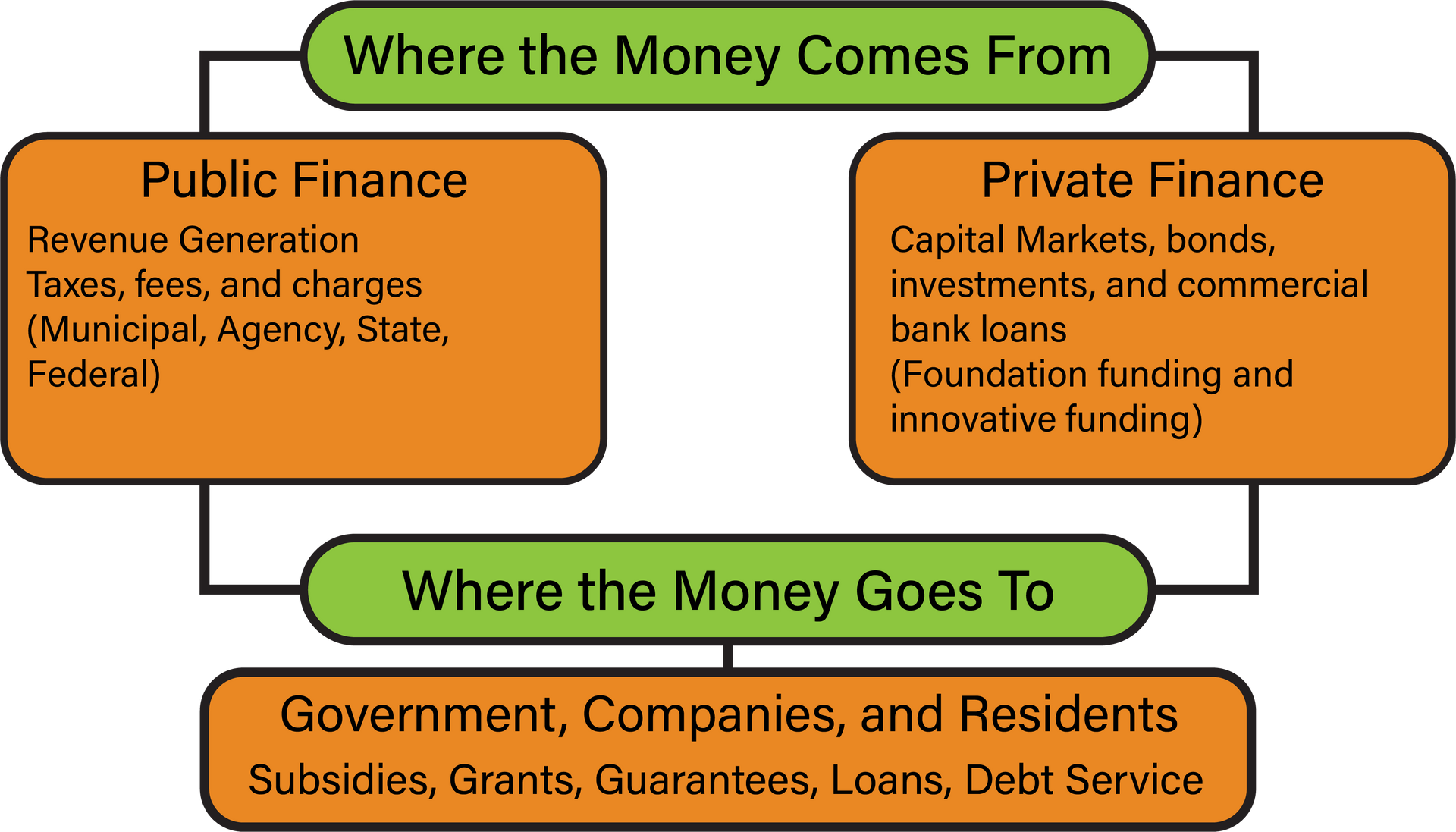
Source: Climate Resilience Consulting
Generally in the context of local government financial dealings, funding is understood to mean money that does not need to be repaid, like a grant, while finance is understood to mean money that must be repaid, like a loan or debt service on a municipal bond.
Most municipal governments rely on bonds to finance their infrastructure investments. Bonds are either general obligation, meaning they are serviced by taxes, or revenue, meaning they are serviced by a tax or fee. Green bonds are a type of revenue bond that is mentioned in this guide. When a project has revenue associated with it, it is considered “bankable,” in that investors may be interested in providing capital to the project.
Government bonds are generally rated by one of the credit rating agencies - such as Standard and Poors Moody’s or Fitch. This credit rating indicates the agency’s assessment of the ability of the issuing agency to pay back the debt. Increasingly, credit rating agencies are examining the physical risks of climate change in their assessments.
Finance and accounting professionals in local government are fundamental to the success of resilience finance. This is because they lead interactions with the rating agencies and co-create annual economic planning documents. One example is the capital improvement plan (CIP) or capital investment plan, a planning and fiscal management tool used to coordinate the location, timing, and financing of capital improvements over a multi-year period.
There are signs that investors across the public and private sectors are keen on climate resilience investment. Finance for adaptation increased by 53% - reaching USD 46 billion globally - in 2019/2020 compared to 2017/2018. However, in the U.S. and Canada, funding specifically for adaptation decreased by 98 percent between 2019 and 2020, and funding for dual uses (adaptation and mitigation) projects decreased by 82 percent.[2][ 1 ]Government was the sole funder of adaptation-specific projects in both years; dual uses projects benefitted from both public and private investment in 2019 and only public investment in 2020. In 2019, the Global Commission on Adaptation estimated that “a (U.S.) $1.8 trillion investment in adaptation measures would bring a return of (U.S.) $7.1 trillion in avoided costs and other benefits.” Hopefully, as we better understand and communicate the immense value in climate resilience investment, and not only from a financial perspective but also in terms of the compounding community benefits, many more opportunities will emerge to help fill the gap in resilience funding and finance.
[1] Aggregated figures, CPI's Climate Landscape of Climate Finance Database. Available at: https://www.climatepolicyinitiative.org/wp-content/uploads/2022/01/2019-2020_GLCF_Data.xlsx
[2] Percentages were calculated using data provided by CPI’s Global Landscape of Climate Finance 2021.
Got Challenges? Find Solutions.
Despite recent growth in funding and finance opportunities, many communities - particularly small and medium-sized ones - have a difficult time securing private investment for equitable climate resilience. These projects are large and complex, they require large-scale capital mobilization, and they’re highly sensitive to local politics. Local governments may face a variety of challenges, from a lack of resources, funding, or political will to a mismatch between older plans and community needs.
Do the challenges below sound familiar to you? If so, check out the rest of this guide to find ideas and solutions.
Traditional accounting practices and economic assessments aren’t working to get my projects off the ground.
Do you find (or do you worry) that your projects’ cost-benefit assessments prioritize wealthier communities over those who have the most to gain from climate resilience investment, such as LMI and BIPOC communities?
- In many climate resilience projects, benefits - including direct revenue, economic activity, and environmental and social improvements - accrue years after project completion. Also, project benefits include things such as improvements to the environment and quality of life, which are poorly understood, and difficult to quantify. Cost-benefit assessments privilege benefits to high-dollar value assets, meaning projects in lower-resourced communities may have a lower cost-benefit ratio than those in well-resourced communities.
Are you struggling to attract investment in your projects because they do not generate revenue?
- Many climate resilience projects don’t have a direct revenue source. Unlike renewable power, for example, that generates energy that can be sold, a flood mitigation project does not have a revenue stream. Projects often fail to attract investment because investors consider projects without revenue associated with them as “unbankable.” Projects need revenue (including from taxes and fees) in order to pay back debt, for instance, debt service a bond.
Is difficulty articulating or quantifying anticipated benefits making it hard to use traditional revenue-generating tools for your project?
- Many climate resilience projects struggle to incorporate traditional revenue-generating tools - such as rates or taxes - because anticipated benefits may be years away, related to potential avoided loss and/or experienced by beneficiaries that did not pay for the project.
Are you having trouble getting a large project off the ground because you don’t have a revenue source to repay debt financing?
- Many climate resilience projects are large and complex, requiring large upfront expenditures. Therefore, they often need debt financing, such as bonds. Debt financing requires identifying and committing to securing a dependable revenue source that will repay investors over a longer time period.
Learn how to design projects that address these barriers by exploring:
- Characteristic 5: Seek a variety of funding and finance types to cover all stages of project life.
- Characteristic 7: Use comprehensive accounting practices that make a strong business case for action.
- Characteristic 8: Ground project processes and outcomes in resilience metrics.
Are you interested in using new or “innovative” finance tools, such as social impact bonds, but are worried that they may carry extra risks or costs because they haven’t been around for very long?
- Several newer and “innovative” finance tools, such as social impact bonds and insurance-linked securities, have emerged in funding and financing infrastructure for adaptation and resilience projects. These tools are largely unproven in the mainstream financing market. Innovative financing mechanisms may be more difficult to use in the near term since there is perceived transaction risk due to a lack of precedent and investment performance data.
Check out these sections to learn more about these mechanisms and how you can build projects that are ready to take advantage of them:
- Characteristic 2: Get buy-in from community and government leaders in positions of power.
- Characteristic 5: Seek a variety of funding and finance types to cover all stages of project life.
- Characteristic 10: Benefit from policies that incentivize climate resilience action.
I don’t have the staff capacity I need to get started on climate resilience projects.
Do you have a limited budget? Small staff and lack of administrative capacity? No time left for new responsibilities?
Do you find that there is a lack of resilience leadership or political will to allocate resources to resilience or social equity projects, especially those that may accrue benefits beyond an election cycle?
Do you see that grant funding is available but you don’t have the capacity to apply for it?
- Even if grant funding is available, it can be difficult to harness resources to design funding ideas and technical capacity for grant writing and administration may be lacking for securing grants or attracting investors. Sometimes, grant administration rules are so onerous that jurisdictions don’t apply.
Do you struggle to get started on projects because you need upfront investment to cover project planning tasks?
- Many debt service tools, such as taxes, require administrative resources to generate broad public support to meet voter approval thresholds.
Do you lack the technical or administrative capacity to find the multiple sources of funding needed to implement a large project?
- Adaptation and resilience projects may be large in scale and designed to provide myriad benefits. Larger projects may require tapping into different funding sources to be realized. Long-standing relationships and a history of cooperation between agencies, departments and/or investors may be lacking.
Learn how to increase capacity AND reduce capacity needs by exploring:
- Characteristic 1: Use multi-scale cross-sector partnerships to increase project capacity.
- Characteristic 2: Get buy-in from community and government leaders in positions of power.
- Characteristic 6: Bundle projects by program to pursue joint funding and finance.
The people I talk to just don’t understand why or how to implement climate resilience projects.
Are you getting conflicting guidance from various stakeholders about what’s most important in your community? Is the climate resilience agenda not a priority in your community? Do people in your jurisdiction not understand why multiple agencies or departments need to be involved in building climate resilience?
- Planning for adaptation and resilience projects is challenging because at the programmatic and project level, communities can face conflicting guidance about what the government’s overall short and long-term plans are and what needs to be done to build resilience. For instance, a state may advocate that coastal communities consider sea-level rise in their decisions while also asking to increase their housing stock.
- Sometimes finance staff, legal staff, elected officials, and others have little knowledge of climate resilience or don’t have the capacity to learn about and act on climate resilience needs.
- Departments that have not traditionally considered the future climate changes or collaborated or shared resources may need to do so in order to attract investment (and make a project successful).
Learn strategies to overcome these challenges by exploring:
- Characteristic 1: Use multi-scale cross-sector partnerships to increase project capacity.
- Characteristic 2: Get buy-in from community and government leaders in positions of power.
- Characteristic 7: Use comprehensive accounting practices that make a strong business case for action.
Is there a lack of alignment across stakeholders in your local government?
- When incentives and regulations misalign across local governments,investors can find it difficult to assess projects.
Are you trying to get financing on a project-by-project basis?
- Creating financing structures and jurisdiction for each project increases transaction time and costs. Infrastructure experts estimate that the use of lawyers, engineers, and other advisers can equal 1-5% of project costs that prove difficult to recoup since they are not capitalized. For resilient infrastructure projects, transaction and development costs may even be higher per project because limited data on financial and risk performance makes deal evaluation more complicated.
Check out these characteristics to explore solutions:
- Characteristic 1: Use multi-scale cross-sector partnerships to increase project capacity.
- Characteristic 6: Bundle projects by program to pursue joint funding and finance.
- Characteristic 10: Benefit from policies that incentivize climate resilience action.
I need support to center social equity in climate resilience projects.
Are you looking to learn how and why to center social equity in your climate resilience projects?
- Communities with the highest climate risk are often those that struggle to address those risks because they have relatively fewer resources, capacity, safety nets, or political power due to discrimination and exploitation. These same communities are often deprioritized for climate resilience investment.
- Existing institutionalized funding and financing practices - including emerging climate risk disclosure guidelines - could further increase disparities in community resilience if such practices do not change to explicitly remove inequity.
Learn how to center equity in climate resilience funding and finance by exploring:
- Characteristic 3: Prioritize equity in all project decisions.
- Characteristic 4: Co-develop climate resilience projects with community residents.
I’m encountering regulatory barriers.
Lots of barriers are outside the control of local governments. For example:
- Information about, and measures to address, risks from climate change are not incorporated into most policies governing public and private institutions.
- The absence of quantitative data on the financial and risk performance of resilience infrastructure projects exacerbates this problem which can incentivize risky behavior.
- Public and private sector programs will likely soon be asked to better account for climate risk.
- Few regulatory incentives and policies exist to attract and secure private investors effectively. Climate risk is often absent or underemphasized in decision-making processes for investors.
- Because climate change is often perceived as slow-moving with impacts far into the future, climate risks are undervalued or not accounted for in many types of market investments.
- Government policy may lag investor action.
- Procedural and administrative requirements outlined in both state and federal funding sources can make it difficult to combine funding streams.
This tool won’t make them go away, but it can help local governments and the folks that support them cope with them, work around them, and work to change them. Check out:
- Characteristic 8: Ground project processes and outcomes in climate resilience metrics.
- Characteristic 10: Benefit from policies that incentivize climate resilience action.
To be ready-to-fund, projects need to connect to existing local government plans. Without strong plans:
- Infrastructure needs are unknown
- Project pipelines are absent, not well-communicated, or fail to center social equity.
- Infrastructure services in high climate risk areas may be deprioritized while community members continue to rely on them.
- The number of projects the community needs is unclear. When the number of projects is unclear, investors find it difficult to justify investing in diligence and credit-evaluation expertise or in partnerships.
- There is a lack of integration between the project proposal, design processes, implementation, and funding/finance processes.
Check out Characteristic 9: Clearly connect to local government plans to learn more.
10 Characteristics of Ready-to-Fund-Projects

Characteristic 1: Use multi-scale, cross-sector partnerships to increase project capacity.
What and Why

Ready-to-Fund Resilience Projects leverage supportive partnerships to increase potential funding and finance available for projects. Leveraging supportive partnerships can increase local governments' capacity to obtain climate resilience dollars by:
- Facilitating community collaboration.
- Identifying, quantifying, and actively mitigating risk.
- Improving investor confidence.
- Improving project bankability.
- Increasing efficiencies of scale.
- Building and transferring knowledge.
- Accessing new or pooling existing funds.
- Advocating for enabling policy and climate resilience funding criteria via partner coalitions.
For example:
- Academic institutions could quantify risks and deliver resources and expertise to a government's climate resilience work.
- The local business community could help quantify the multi-benefits to the community of climate resilience investment.
- City departments, such as transportation, with access to significant resources, could ensure that investments include climate resilience criteria and components.
How
Identify potential partners and the types of support they can provide to your local government’s climate resilience goals. Potential partners include staff and departments within the local government, organizations, and networks in the community at large, neighboring jurisdictions, and private sector firms and funders.
Internal Local Government Partners Who: Departments with mandates or missions that may be related to climate resilience projects such as finance, legal, public works, housing, public utilities, parks and recreation, public health, social services, planning, transportation, and economic development.
Partnership Ideas:
- Pool funds from a variety of sources.
- Grow consensus around, and demand for, prioritizing funding and finance for climate resilience projects.
- Establish internal champions who can address resistance to, and bottlenecks in, the climate resilience project cycle (see Characteristic 2: Get buy-in from community and government leaders in positions of power for additional information).
Partnership Benefits:
- Identify and connect internal champions for climate resilience.
- Break down silos and normalize the idea that climate resilience is not an isolated agenda but sector agnostic, community-wide, and inextricably intertwined with each municipal department and decision-making body.
- Reduce costs by incorporating climate resilience elements into existing plans and projects.
Community Partners
Who: Community-based organizations, faith-based organizations, local and national businesses, resilience hubs [1] , and academic institutions. For information about connecting directly with community residents, see Characteristic 4: Co-develop climate resilience projects with community residents .
Partnership Ideas:
- Create a "brain trust" of experts to help identify and quantify risks as well as deliver resources and expertise to a government's climate resilience work.
- Provide insight into how to take advantage of commerce and industry trends.
- Better understand community priorities, particularly in places with high climate risk and vulnerability and low adaptive capacity, such as BIPOC and LMI communities.
- Support project design.
Partnership Benefits:
- Strengthen public support for both climate resilience and climate mitigation.
- Connect local government actions to community needs and priorities.
- Increase capacity to address many different aspects of climate resilience-building.
Neighboring Jurisdictions
Who: Other towns, cities, counties, tribal governments, regional authorities, state governments.
Partnership Ideas:
- Exchange local know-how and understanding of innovative financing mechanisms.
- Participate in regional systems that support coordination between geographies.
- Contribute cost-sharing, and reduce the need for new project investment.
- Ensure that the most appropriate jurisdiction is pursuing funding aligned with community priorities.
- Support an intentional and holistic approach to climate migration and managed retreat by identifying safe places for relocation and avoiding rebuilding in areas that will face continued destruction.
Partnership Benefits:
- Provide a sense of confidence to potential investors in terms of project scale and regional buy-in.
- Increase cost-effectiveness.
- Share knowledge.
- Avoid risk transfer and maladaptation by considering project impacts on a regional basis.
Private Sector Firms and Funders
Who: Corporations, project developers, financial institutions, private equity and venture capital firms, development banks, impact investment firms, philanthropies, and engineering firms.
Partnership Ideas:
- Establish relationships with funders at project outset to plan for financing needs for the entire life of a project.
- Calculating resilience into project design and feasibility reporting.
- Create project accountability structures that enhance the bankability of equitable resilience projects.
- Strategize on cost-share and other finance scenarios.
- Assume the first level of risk in the projects' finances to inspire other investors to contribute.
- Spread a project’s cost over a more extended period and free up public funds for investment in sectors in which private investment is impossible or otherwise inappropriate.
Partnership Benefits:
- Strengthened 'bankability' of project pipelines: based in part on experience from similar work with other local governments, private partners may be in a better position to consider revenue-generating potential, provide financial expertise to projects, create applications that reduce transaction costs, and even focus on achieving scale in specific sectors.
- Increased attractiveness of a project for investment and greater alignment of the outcomes required by the local government and what the private sector can deliver.
- More accurate life-cycle costs.
- Identification of risks and appropriate mitigation strategies.
- Feasibility and fallback arrangements.
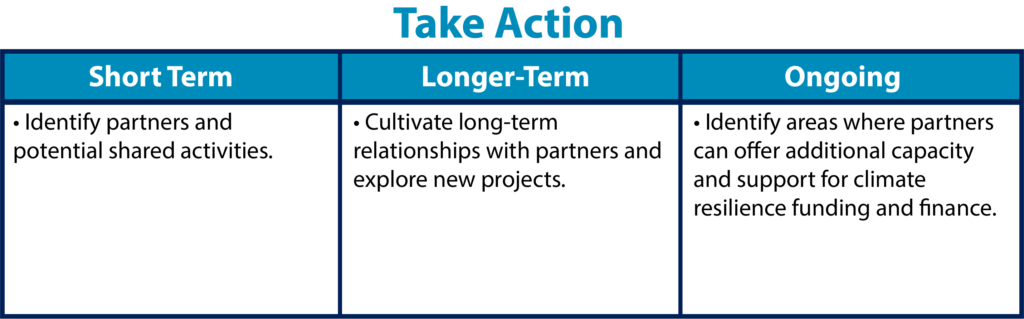
Think and Act
Ask
- How do we identify and leverage partnerships to support municipal resilience leads' capacity to advance the community climate resilience agenda?
- How can we de-silo a climate resilience project and show its connectivity with a variety of municipal priorities?
- What untapped wells of leadership and opportunity exist in the community and what goals do these leaders share?
Identify Partners
- Internal local government partners
- Community partners
- The private sector
Promising Practices & Innovation
Prince George's County, MD: Partnering With Private Sector Firms to Expand Their Capacity and Meet Project Goals. In 2014, Prince George's County, Maryland, needed to meet the requirements of both EPA Clean Water regulations and the regional Chesapeake Bay Watershed Implementation Plan. This meant green infrastructure retrofits for 30% of untreated developed areas to be completed by 2017. To meet this challenge, the county entered into a Community-Based Public-Private Partnership with Corvias, an infrastructure and facilities management company. This newly created Clean Water Partnership (CWP) supplemented public stormwater fees with private financing options and private investment throughout the project development and implementation phases . Crucially, the CWP agreement also included co-benefits for local residents , as 50% of construction had to be subcontracted to local certified small, minority, and women-owned businesses. Plus, at least 51% of man-hour/job participation had to be filled by county residents. Realizing a need for more local participation to meet construction and maintenance goals, CWP leaders instituted a variety of educational and supportive services programs to expand the capacity of local, small, and minority firms in stormwater management and green infrastructure projects. By 2017, CWP completed and certified over 2,100 acres, using more than 85% of small, minority, and women-owned businesses in the county, and saved more than 40% compared to traditional budgets.
Increasing Capacity and Reach Through Regional Advocacy
Coalitions of jurisdictions from across a region can advance agendas at higher levels of government and create more enabling policies. [1] For example, a national leader in regional climate resilience collaboration is The Southeast Florida Regional Climate Change Compact "a decade-old partnership between Broward, Miami-Dade, Monroe, and Palm Beach counties, to work collaboratively to reduce regional greenhouse gas emissions, implement adaptation strategies, and build climate resilience within their own communities and across the Southeast Florida region."
Together, local governments and partners can advocate for state and national government leadership by:
- Providing cover for local governments when facing administrative pushback in their pursuit of innovative resilience and equity-focused solutions.
- Creating a task force to study an issue.
- Developing shared language and objectives for plans and policies.
- Advocating for policies and laws that create an enabling environment for finance-ready, equitable climate resilience projects, such as:
- Incentives that integrate climate resilience into day-to-day governance activities.
- Incentives that prioritize low-to-moderate income (LMI) and black, indigenous, and people of color (BIPOC) communities in local government actions.
- Policies and laws that enable the use of innovative financing mechanisms such as outcomes-based contracts and bonds.
- Increased incentives and lower barriers for local governments to use best practices for community engagement, such as providing stipends for community members to participate in planning processes.
- Provisions to make it easier for local governments to combine funding streams for resilience projects.
[1] Resilient Nation Partnership Network, FEMA, and NOAA. “Building Alliances for Equitable Resilience,” 2020. https://www.fema.gov/sites/default/files/documents/fema_rnpn_building-alliances-for-equitable-resilience.pdf .
Additional Resources
Characteristic 2: Get buy-in from community and government leaders in positions of power.
What and Why

Ready-to-Fund Resilience Projects get buy-in from community and government leaders in positions of power to increase resilience projects' level of priority in the local governments' portfolio and counter-resistance to climate resilience action. Obtaining buy-in from community and government leaders in positions of power can:
- Grow untapped support for resilience funding and finance.
- Counter pushback from individuals or departments with veto power that resist resilience investment.
- Ensure the longevity of in-progress resilience projects beyond election cycles.
- Generate broader buy-in to increase investment opportunities.
- Align cross-sector departments and resources toward a common guiding vision to create project efficiencies and mutual benefits.
- Help to prioritize climate resilience projects within a competitive funding environment.
- Increase accountability for achieving resilience project impacts.
How
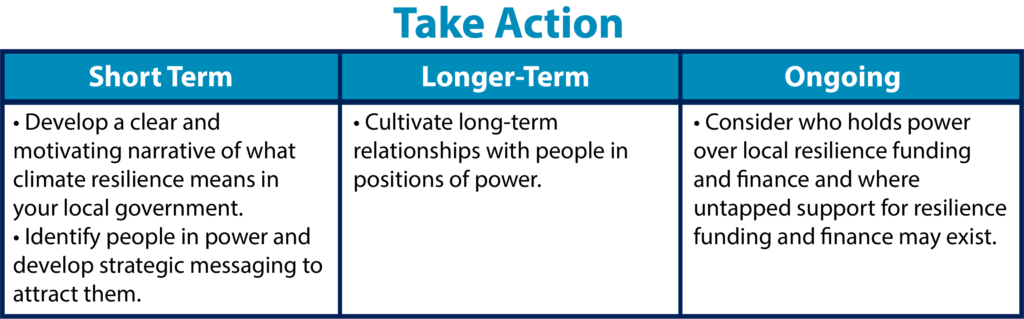
Refine the value proposition of climate resilience. Developing a clear and motivating narrative of what climate resilience means in your local government is critical to generate buy-in and to align cross-sector departments and resources toward a common guiding vision for the community. With strong community support, media attention, and community organizing, this refined resilience vision can improve the appeal of climate resilience work for people who may be resistant to it. This vision may be most compelling if you can demonstrate that it will comprehensively address multiple community and local government priorities, for example: infrastructure, housing, public health, economic development, food security, and climate change mitigation. One illustrative example is demonstrating the benefits of climate-resilient natural or green infrastructure projects, which can bring benefits for infrastructure systems, water, and food security, public health and safety, wildlife habitat, and greenhouse gas mitigation.
Identify people in power and develop strategic messaging to attract them. Consider who holds power over local resilience funding and finance and where untapped support for resilience funding and finance may exist. This could include local government leaders in finance, legal, public works, the town council, the mayor's office, or community influencers such as business leaders, philanthropists, impact investment firms, and economic development agencies.
Identify common causes or multiple benefits that can generate support from champions across departments, agencies, businesses, nonprofits, and others to pool resources and share responsibilities. Determine how these players could address barriers around resilience funding and finance. Strategic messaging is essential to attracting these influencers and getting them to support obtaining climate resilience funding and finance.
Target Audiences and Respective Strategic Messages:
Federal Funders
Strategic Messages:
- Quantifiable costs and benefits, reliable data, program and policy objectives, and logistical procedures.
- Letters of support that demonstrate community buy-in.
Example:
- Compare costs and benefits of different actions to achieve a specific goal, and estimate the positive impacts on amenities that people value, such as health and clean air as well as increase safety and avoid damages and expenses.
- Ask the business community or other key leaders to assist by preparing an economic study that frames the long-term scale of the problem. One such report is the Natural Hazard Mitigation Saves Report, updated in 2019, which indicates each dollar invested in mitigation saves between $4 and $11.[1] A local version: Building-level adaptations in Miami Dade such as floodproofing, elevation, and the addition of permeable surfaces will generate $9 for every $1 invested and support 3,190 job years, which is one job per person each year, through 2040. [2]
Private Funders: foundations, philanthropists, impact investors
Strategic Messages:
- Climate change impacts on people and the environment, obligations to future generations, equitable outcomes, and environmental stewardship.
Example :
- Communicate how a project will benefit underserved communities; who will bear the cost and who will receive the benefits.
- Organize site visits and present community input and levels of buy-in. [3]
- Encourage the business community to get involved by communicating the economic costs of inaction and, conversely, the multiple benefits of equitable resilience investment.
Local Government Leaders
Strategic Messages:
- Highlight the interconnectivity between your different agendas and shared goals. Get them to see the connections.
- Begin with trusted colleagues who can advocate for this work from within their own departments.
- Appeal to the bottom-line.
Example :
- Point out that having more affordable housing in areas outside a floodplain will support a larger workforce that will contribute to the local government tax base.
- Change the conversation around debt by showing the costs of inaction and credit implications.
- Failing to take more action in the near term to bolster climate resilience could impact economic and financial indicators such as: loss of tax base, revenue loss, downgrade in a municipal credit rating, decreased ability to pay debt, disclosures, and valuation.
Elected Officials
Strategic Messages:
- Demonstrate to elected officials the direct and indirect benefits to companies at the regional level - whether it’s reduced damage to assets, fewer business interruptions, or enhanced economic activity - to foster buy-in.
- Identify and engage beneficiaries who can support big projects.
Example :
- Tie-in effective economic arguments targeting major regional players or potential funders.
- Since many climate resilience projects build capacity rather than serve as 'ribbon cutting' enhancements, celebrate these less 'visible' achievements. This can help retain momentum and interest. "Ribbon-cutting" ceremonies for resilience initiatives can generate support and boost their importance.
[1] Council, Multi-Hazard Mitigation. "Natural Hazard Mitigation Saves: 2019 Report." (2019).
[2] ULI Southeast Florida/Caribbean. “The Business Case for Resilience: Southeast Florida - Americas,” 2020. https://seflorida.uli.org/business-case-for-resilience-southeast-florida/ .
[3] Smith, Kris. "Building Funding Strategies for Flood Mitigation Projects." Headwaters Economics. September 09, 2021. https://headwaterseconomics.org/natural-hazards/funding-strategies-flood-mitigation/#how .
Think and Act
Ask
- How are we defining climate resilience in our community and how does that connect to community needs and priorities?
- Who holds significant decision-making power over resilience funding and finance? What are the opportunities to recruit them to become supporters of your vision and projects?
- Who in the community may be a leader and champion for resilience funding and finance?
- What strategic messages about the value proposition of climate resilience are most relevant to the audience we are appealing to?
Identify Partners
- Business community leaders
- Neighborhood association presidents
- Faith leaders
- Large regional players who influence money flows and elections. For example: hospital systems, transportation authorities, major employers, and housing developers.
- Academic institutions and other firms that can complete quantitative assessments to support a strong narrative around resilience funding and finance.
Promising Practices & Innovation
Pittsburgh, PA: Developing a Body to Coordinate and Communicate a Climate Resilience Vision. The Pittsburgh Mayor’s Fund, OnePGH 501(c)(3), coordinates government, private and philanthropic capital to leverage additional value from public assets to benefit residents. The grand vision foresees a streamlined Pittsburgh, where government, nonprofits, and corporations pool resources into a separate tax-exempt organization to fund $3.5 billion in commitments by 2030. Since 2015, the City has assembled more than 2,000 residents to identify the city’s profile for shocks and stresses as well as the most critical projects poised for implementation. Since 2018, the Division of Sustainability and Resilience within the Department of City Planning has assembled more than 125 partners into working groups to identify such critical projects. The fund focuses on 10 areas: affordable housing, climate and environment, arts and culture, workforce development, early childhood, mobility, water delivery, stormwater, government performance and innovation, and critical communities. In lieu of taxes, local corporations and businesses (such as a major health care organization, for example) can provide monies to fund city projects that align with their organizational mission. For example, local hospitals can invest in community green infrastructure and tree-planting projects that enhance community health outcomes. By identifying community leaders in the public and private sectors and connecting their investment to a community problem that aligns with their values, the City effectively created a mechanism that fosters buy-in while growing the pool of resources available for climate resilience funding and finance.
Attracting Investors by Increasing Municipal Creditworthiness Many credit rating agencies now account for climate resilience in their credit ratings for state and local governments.
[1} A major natural disaster could shock local economies and increase stress on municipal operations, triggering decreased tax revenues and higher debt burdens. These outcomes could prompt a credit rating downgrade.
[2]
The C40 Cities
Good Practice Guide on Creditworthiness
identifies a number of key areas in which to focus to enhance municipal creditworthiness
[3] , including the development of a climate-smart, long-term capital investment plan, and a pipeline of public infrastructure projects that seek to estimate:
- The service delivery issues for a municipality in the present and future.
- Priority projects to address these gaps.
- Project costs.
- How these projects should be sequenced and delivered over time.
Doing this can help attract potential investors. It reflects good governance and planning, particularly when greenhouse gas mitigation and climate resilience building are central to the plans.
To further resilience and other types of investments, local governments can improve their creditworthiness and achieve financial autonomy to unlock available capital by strengthening their financial systems. They can charge users for infrastructure, improve the collection of arrears, use technology to reduce the cost of revenue administration, and deploy new and innovative models of finance and investment.
Consider Characteristic 9: Clearly connect to local government plans for additional insight into and resources for developing long-term 'climate smart' CIP plans.
[1 and 2] iTigue, K. (2019, August 5). Climate Change Becomes an Issue for Ratings Agencies. Inside Climate News .
https://insideclimatenews.org/news/05082019/climate-change-ratings-agencies-financial-risk-cities-companies/ .
[3]
https://c40.my.salesforce.com/sfc/p/#36000001Enhz/a/1Q000000Mm1Z/73R8uDzYsEDJuSiPokTVpj97.J17hc02Q829NH9fwPk
Additional Resources
- The Anthropocene Alliance offers guides for community activism. Employing methods described in them, community members can demonstrate widespread support for local government resilience initiatives. Most importantly, coordinated community activism may help local initiatives gather wider support from influential bodies, such as certain universities, businesses, or elected officials at higher scales of government who initially may be resistant to resilience measures.
- The World Bank Group Guide to Climate Change Adaptation in Cities offers a sample of climate hazards and adaptive responses across sectors (see page 54). These tables can provide insight into cross-sector agencies impacted by various regional hazards and provide a foundation for building a cross-sectoral resilience agenda.
Characteristic 3: Prioritize equity in all project decisions.
What and Why
Ready-to-Fund Resilience Projects prioritize investment communities that are both highly exposed to climate risks and have fewer resources, capacity, safety nets, or political power to respond to those risks because of current or historic discrimination. This includes Black communities, Indigenous communities, other communities of color (BIPOC communities), low and moderate-income (LMI) communities, as well as immigrant communities and communities with residents at risk of displacement. Ready-to-Fund climate resilience projects seek to increase equity for these communities and address equity in all aspects of climate resilience projects' processes. Prioritizing equity in all project decisions can:
- Attract different funding sources, including philanthropic and federal programs with an aim to build equity.
- Enhance community trust.
- Decrease demand for, and the cost of, social safety nets.
- Create long-term community economic vitality by ensuring accountability to outcomes that reflect real community needs and assets rather than assumptions.
When the needs of these communities are met, the entire community shares the benefits.
How
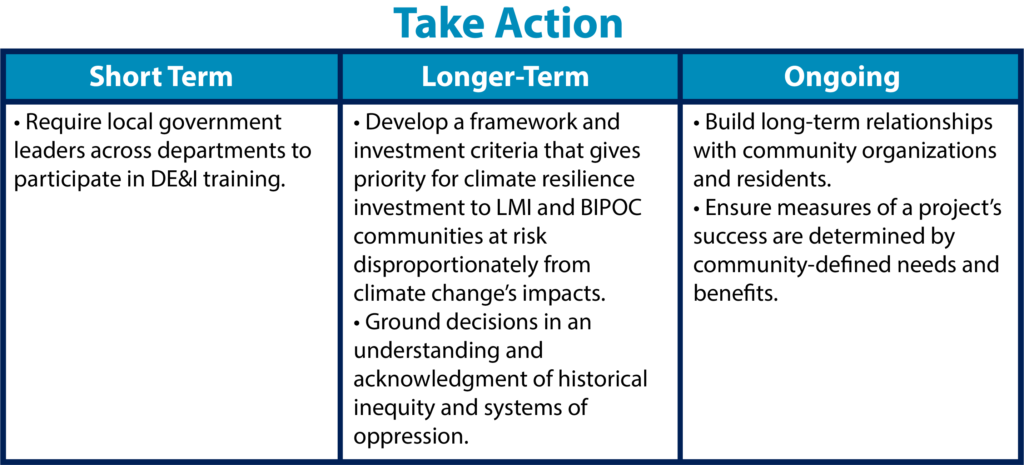
Provide equity training to project teams.
It is important for all project staff and partners to participate in equity training that is tailored to local contexts. This training should teach participants to recognize discrimination, particularly institutional racism, that shapes the dispossession of BIPOC communities and contributes to massive disparities in wealth.[1] This can help projects avoid and correct institutional discriminatory practices that have influenced disparities in wealth and adaptive capacity in local communities.
Examples of those practices and their outcomes include:
- Limits on wealth-building such as restricted access to credit and homeownership decrease the perceived value in a community and can reduce access to traditional financing that favors high-value assets.
- Historical disinvestment increases existing needs relating to rising deferred maintenance and the lack of sufficient and sustainable infrastructure. These affect public assets such as water, stormwater, transportation, health, and schools.
- Major federal investment in infrastructure, such as the interstate highway system, has disrupted and physically fragmented LMI and BIPOC communities.
Communities with fewer resources will possess limited capacity to pursue funding, secure financing, and deploy monies to support adaptation and resilience projects. Existing institutionalized financial practices will only serve to further this negative feedback loop if such practices do not change to incorporate equity concerns. For example, credit rating agencies' downgrading of municipal bond ratings for communities with challenges in recovering from climate-related disasters will only raise borrowing costs for funds needed to recover economically in those communities.
Create systems to center equity in the way climate resilience investments are prioritized. In order to prioritize BIPOC, LMI, and other communities with high climate risk and low capacity to respond to that risk, work with partners to establish criteria and incentives for equitable climate resilience-building processes. In addition to establishing these criteria, seek to establish mandates for their use through local policies or state or federal legislation. It is also important to use project selection and prioritization mechanisms that center these communities and their needs. See Characteristic 5: Seek a variety of funding and finance types to cover all stages of project life for how to center humans and equity within cost-benefit analyses.
Work on shifting power to communities.
The most impactful way to center equity is to shift power to communities themselves. This includes creating systems by which community residents are directly involved in prioritizing projects and contributing to their design, execution, and ongoing evaluation. It requires proactive community relationship building, connectivity, and collaboration. See Characteristic 4: Co-develop climate resilience projects with community residents for more information.
Evaluate long-term progress.
Efforts to include equity in decision-making tend to reflect a 'one and done' mentality as leaders think the hard work has been done after completing Diversity, Equity, and Inclusion (DE&I) training or conducting a vulnerability assessment. Centering equity is never "complete" and it can take years to see progress.
Preventing the perpetuation of inequalities requires reevaluating projects to gauge and address inadequacies. Improvement requires follow-up and robust evaluation systems as well as greater connectivity, collaboration, and mutual support among communities and local decision-makers. Local governments should establish a system to evaluate long-term progress based on measures of success determined by community-defined needs and benefits.
For insight into establishing a robust system for evaluation and long-term performance measurement, see Characteristic 8: Ground project processes and outcomes in climate resilience metrics.
[1] Hughes, Sara, Sarah Dobie, Kirsten Schwarz, Genevieve LaMarr LeMee, Madeleine Lane, and Andres Gonzalez. "Centering Racial Justice in Urban Flood Resilience Policy and Planning: Tools for Practitioners." Environmental Justice (2021).
Think and Act
Ask
- What would it look like to center equity in how we prioritize resilience projects, run internal processes, and make decisions?
- What are the stages of our internal processes for climate resilience projects - from project design through long-term monitoring - in which we need to embed equity? Who is making decisions at each stage?
- How does the way in which we raise and spend money impact equity in our community?
Identify Partners
- Local government staff and elected officials
- Individuals who will be impacted by project outcomes
- Community-based organizations
- Business partners
- State and national government policymakers
Promising Practices & Innovation
Hampton, VA: Seeking Solutions From Community Residents
In response to community concerns about the effects of climate change, the City Council of Hampton, Virginia, included community stakeholders, city staff, and consultants when establishing the
Hampton Comprehensive Waterways Management Steering Committee in 2010. This committee began a decade of engagement to identify the most effective solutions for meeting local needs while developing residents' trust and buy-in, represented by the success of projects over the past five years.
Phase I of these solutions started with an 18-month research and planning process that included four public workshops that examined citizen observations, concerns, and proposed solutions. The workshops sparked the analysis and strategies for a citywide plan for resilience. Among its solutions are several ways to include community voices on project design, execution, and maintenance. Ideas from Phase I as well as ongoing community input have helped in designing
Phase II , a pilot process for a watershed project. In this phase, the City has alternated hosting technical design workshops with setting up community meetings that allow residents to help technical experts define new ideas and to provide feedback on materials generated in the design process. This has included selecting the Newmarket Creek watershed area as the most effective for applying, refining, and testing an evaluation tool; continuing to build partnerships for the resilience effort, and developing a community education program. Including community voices has helped citizens own projects and share maintenance costs and ensure accountability for outcomes that reflect the community’s contexts.
Additional Resources
- City of Seattle’s Racial Equity Toolkit offers a process and set of questions to guide the development, execution, and evaluation of policies, initiatives, programs, and budget issues to address the impacts on racial equity.
- Advancing Racial Equity and Transforming Government: A Resource Guide to Put Ideas into Action (Government Alliance on Race & Equity) provides strategies to advance racial equity and government transformation.
- Racial Equity Toolkit: An Opportunity to Operationalize Equity (Government Alliance on Race & Equity) delivers guidance on aligning everyday decision-making with organizational racial equity goals and desired outcomes. This enables equity to be incorporated throughout all phases, from development to execution and evaluation.
- The UK Climate Impacts Programme (UKCIP) offers a range of tools and resources, including a database of case studies, on adaptation to climate change. In particular, LCLIP (Local Climate Impacts Profile) is a resource that local authorities can use to understand exposure to weather and climate in more detail. Another UKCIP tool is the Adaptation Wizard , which takes users (not specifically local governments) through a process to determine vulnerability to climate change, identify key climate risks, and develop a climate change adaptation strategy.
Justice, Diversity, Equity, and Inclusion Training Resources
- USDN Equity Foundations Training is a tool to incorporate a racial equity perspective into sustainability. It provides themes on promoting retail equity, communicating about equality, building a common knowledge of equity, applying an equity lens in your business, and forming racial equity teams. The videos, worksheets, and facilitator guide for equity enables leaders to offer workshops.
- Purdue University’s Understanding Diversity and Inclusion course offers opportunities to build cultural diversity skills and knowledge for creating inclusive environments.
- The Inclusion of minorities in community development training discusses the conceptual foundations of diversity, challenges relating to effective inclusion, successful organizational change methods, and the tools and approaches that can help achieve inclusivity in community-development initiatives.
Characteristic 4: Co-develop climate resilience projects with community residents.
What and Why

Ready-to-Fund Resilience Projects are co-developed with the people most impacted by resilience decisions and directly integrate residents' knowledge and experience into project design and implementation. Establishing processes, criteria, and platforms for community co-development helps shift funding and finance resources to communities most in need. Co-developing projects with residents can:
- Enhance community trust and buy-in around a project, a key prerequisite for funder interest.
- Better identify and prioritize the funding 'ask.'
- Increase eligibility for funding opportunities that include a robust vulnerability assessment and/community engagement as part of the funding criteria.
- Ensure accountability to outcomes that reflect community needs and assets rather than those reflecting a predetermined view of what resilience should look like.
- Grow investor support by establishing community buy-in.
- Maximize project design and readiness for funding by supplementing content expertise (city planners and engineers) with context expertise (community residents).
How
In developing a funding and financing strategy for adaptation and resilience projects, leaders must address historical injustices by avoiding regressive tools and focusing on equitable processes and outcomes. This includes recognizing the social capital and expertise of communities that will pay for - and be impacted by- a project.
Reassess how community needs and assets are understood via more human-centric vulnerability assessments.
Conduct an equitable and human-centric vulnerability assessment that identifies areas that are vulnerable to climate impacts and what assets are important to community members' daily lives and ability to cope in an emergency. Consider incorporating holistic indicators and metrics that account for disparities in a community's capacity to adapt as well as health outcomes, social vulnerability, etc. This includes leveraging data sources that collect qualitative and quantitative data from community members, such as surveys and outreach sessions that provide information on what resilience means in the neighborhoods.
Likewise, work with residents to understand the root causes of local disparities to better inform local policy decisions. Consider flood mitigation, for example. Key climate adaptation strategies that address the root cause of flood exposure include improving the equitable distribution of environmental amenities that reduce flood vulnerability. These include green infrastructure, strategies that improve housing quality and security and prevent displacing low-income and minority households, financial services to secure property titles so residents can be eligible for recovery grants, and climate adaptation programs and investments that create new jobs and business opportunities for marginalized groups.[1]
Establish a platform for project co-development alongside community residents.
When making resilience decisions and paving the way for multi-generational transformation, design planning, policy, and program solutions alongside community members so they gain ownership over the outcomes and the process that gets them there. This means developing funding processes (e.g., application, review, reporting, etc.) with/by LMI and BIPOC communities that reduce their burden. This also means that community members define what resilience means to them.
For this to occur, municipal resilience leads and community-based organizations can develop an equitable and participatory design process that bridges spaces between engineers, planners, government officials, and community members. This process also can encourage other organizations and leaders to do the same. Involve communities early, often, and always in developing projects that communities need and support. [2]
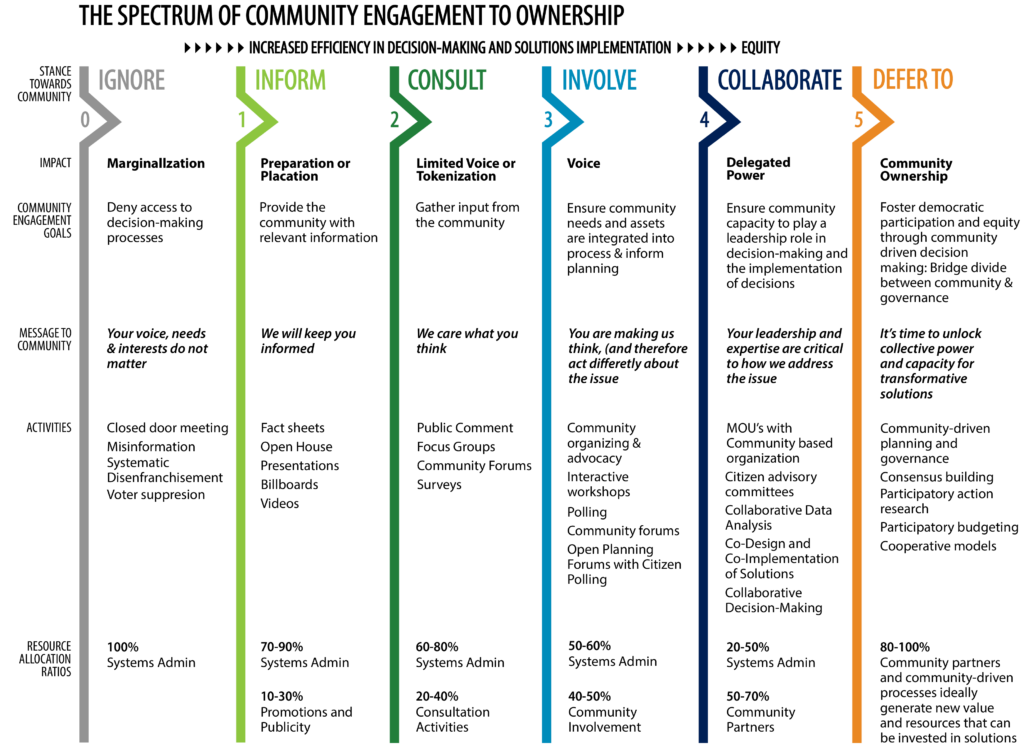
The Facilitating Power Spectrum of Community Engagement to Ownership can help identify where a city's processes fit along the continuum of community co-development. It offers strategies to shift processes toward more holistic resilience project co-development. The content has been piloted with municipal community-centered committees for racial equity and environmental justice in Portland, WA; Providence, RI; Seattle; and Washington, DC; and with the Building Healthy Communities Initiative in Salinas, CA, and developed in partnership with Movement Strategy Center. The Spectrum of Community Engagement to Ownership offers a continuum for facilitating a transfer of power to community leaders, which can help shift funding and finance to community-driven projects:
Figure 2: The Spectrum of Community Engagement to Ownership
Ensure Accessibility
Ensuring accessibility is a key component of this process. Identify sustainable and flexible funding sources to support prolonged engagement processes and provide community support (e.g., childcare, food, stipends, travel, translation). If in-person, the venue should be accessible by public transportation and in a space that is ADA-accessible. Communications should be exchanged in the languages that reflect the surrounding community, and arrangements should be made to accommodate community members with limited resources, mobility, or time to ensure they have ample opportunity to participate. It is also best practice to pay community members for the time they invest in co-creation, just as the other experts are paid for their time.
[1] Hughes, Sara, Sarah Dobie, Kirsten Schwarz, Genevieve LaMarr LeMee, Madeleine Lane, and Andres Gonzalez. "Centering Racial Justice in Urban Flood Resilience Policy and Planning: Tools for Practitioners." Environmental Justice (2021).
[2] Smith, Kris. "Building Funding Strategies for Flood Mitigation Projects." Headwaters Economics. September 09, 2021. https://headwaterseconomics.org/natural-hazards/funding-strategies-flood-mitigation/#how.
Think and Act
Ask
- What is fostering bottom-up leadership in climate resilience?
- To what extent do communities in our jurisdiction possess the self-determination and autonomy to set and act on priorities important to them?
- Are community members and community-based organizations active in planning, designing, executing, evaluating, and monitoring local climate resilience activity?
Identify Partners
- Community-based organizations
- Community members
Take Action
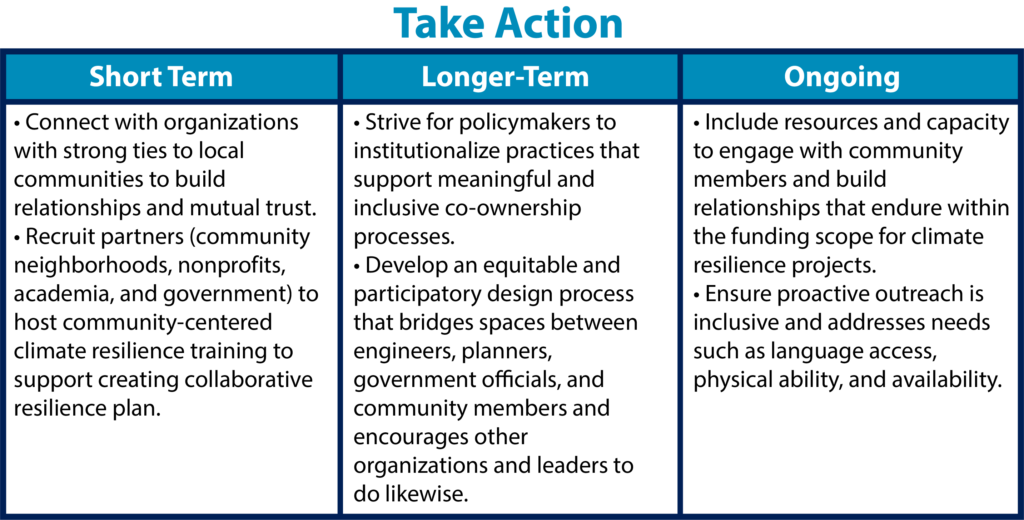
[1] Dillard, Maria. “Inventory of Community Resilience Indicators & Assessment Frameworks.” National Institute of Standards and Technology, April 16, 2021. https://doi.org/10.18434/MDS2-2297.
Promising Practices & Innovation
Fresno, CA: Residents Prioritize Projects via Participatory Budgeting.
In 2014 in Fresno, California, local leaders and state officials started conversations to identify ways to catalyze private investment at scale, especially near the high-speed rail station and surrounding neighborhoods. Their solution was the Transformative Climate Communities (TCC) program, which combined private investments to support local climate action in the top five percent of disadvantaged communities. In perhaps the country’s largest community-based participatory budgeting, Fresno leaders employed an open steering committee to design, select, and help execute the most effective programs. Hundreds of residents attended because anyone who lived, worked, or owned a business or property in the neighborhoods eligible for TCC funding could participate and vote on projects. They simply had to meet an attendance threshold at the regular Community Steering Committee meetings. A consulting facilitator, multiple staff members from the City, and support from the Central Valley Community Foundation effectively administered the process. By year-end 2017, a package of projects proposed by local residents had been selected over four other alternatives and had acquired $77 million in funding from the State of California with further investments of $216 million across 25 projects.
Additional Resources
A number of tools exist to incorporate equity into planning and budgeting processes as well as in procurement and contracting.
- Georgetown Climate Center's Equitable Adaptation Toolkit highlights emerging practice examples of how local governments address the disproportionate socioeconomic risk to climate impacts and engage overburdened communities, as well as how they move beyond equitable adaptation planning and execution of policies that address social equity and climate resilience. The toolbox benefits local governments and community-based groups that focus on equity in their adaptation efforts.
- Facilitating Power’s Spectrum of Community Engagement to Ownership uses various public participation tools that focus on municipal community-centered committees for racial equity and environmental justice in the cities of Portland, Providence, Seattle, and Washington, DC; and the Building Healthy Communities Initiative in Salinas, CA, developed in collaboration with Movement Strategy Center.
- The USDN Guide to Equitable Community-Driven Climate Preparedness addresses gaps in particular adaptation strategies, inclusive community involvement techniques, and core causes of climate risk inequity. It discusses the advantages of community-centered planning for maximizing climate preparation action among low-income communities and communities of color and addresses how to increase resilience by letting those most impacted determine the choices that will affect their lives.
- City of Seattle's Inclusive and Public Engagement Guide provides guidelines about inclusive public engagement useful for local government staff. The guidelines focus on building strong and sustainable relationships and partnerships with people of color, immigrants, and also on recognizing how diversity and a healthy democracy require outreach and public engagement. (A quick guide to the ‘Key Steps to Inclusive Public Engagement’ can be found on Pages 10-12)
Characteristic 5: Seek a variety of funding and finance types to cover all stages of project life.
What and Why

Ready-to-Fund Resilience Projects combine funding and finance from a variety of sources, referred to as 'blended finance' to cover all stages of resilience building from community co-development and project design to execution and longer-term monitoring and performance measurement. Blended finance may include commercial debt and equity, grants, concessional loans, subsidies, and other public support.[1] Leveraging blended finance can:
- Support funding of climate resilience proactively in the wake of disruption.
- Expedite the funding process.
- Ensure that all components of the climate resilience-building process are covered, including grant writing, project planning, and design and execution components.
- Cater to the development and application of climate adaptation plans with a longer-range timeline.
- Open up opportunities for new sources to cover grant match requirements.
[1] https://fmdv.net/admin/Images/Publications/133/FinalAggregationKnowledgeProduct.January2021.pdf
How
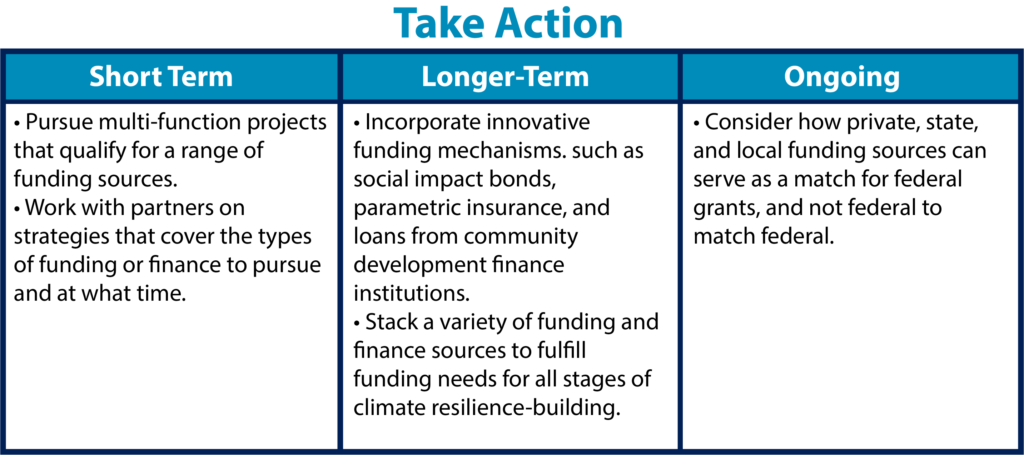
Stack a variety of funding and finance sources.
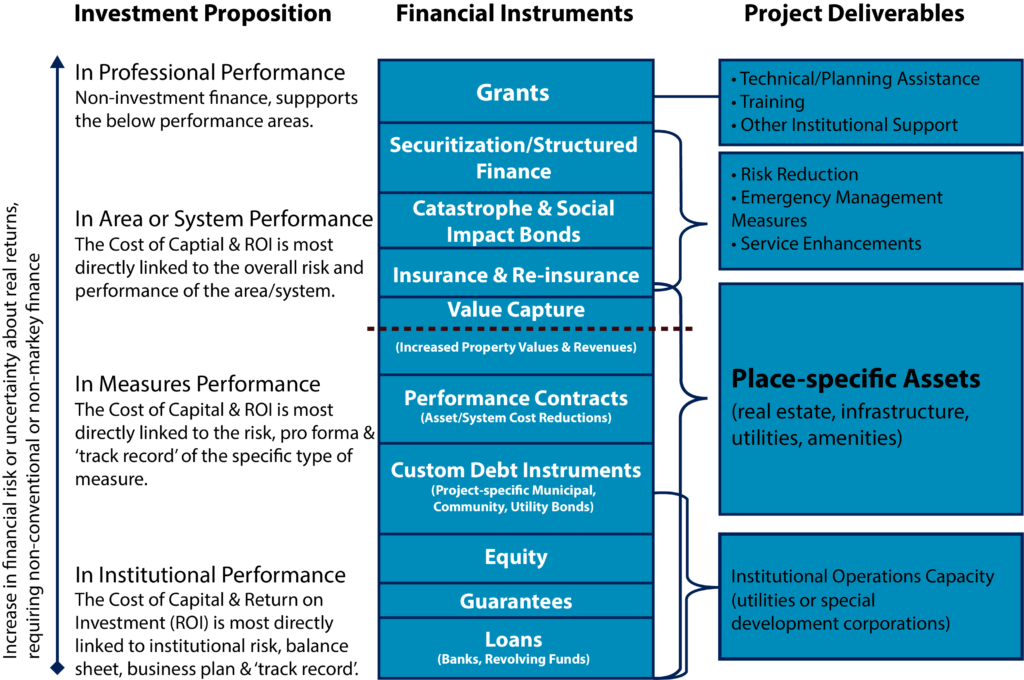
Various financial instruments can be combined at various climate resilience project stages and/or for various deliverables. Different funders may be more compatible with differing components of resilience funding and finance. Search for philanthropy and state and federal fund requirements and use them as the basis for modifying resilience projects to suit funder criteria and identifying what funding source might prove the best fit for a specific project or component of a project. For instance, philanthropies may be best aligned to cover community outreach campaigns, while energy retrofits can be financed by utilities, aided by local energy rebates.
Jeb Brugmann’s Financing the Resilient City: An ICLEI White Paper, offers a sample investment structure for more complete climate resilience projects and the types of funding and finance that may best align with each stage.
Investment Structure for Blended Finance
Incorporate innovative funding mechanisms such as social impact bonds, parametric insurance, and loans from community development finance institutions.
Local governments can employ various ways of raising revenue for climate resilience-building tailored to their political situations, fiscal conditions, and legal barriers. Financing facilitated by banks, cooperative societies, and other non-banking institutions differs from a pay-as-you-go funding approach. Debt financing measures often entail lending money on the promise of future payment with a return generated from taxes or fees. Some governments raise climate resilience funds by bonding against future tax or fee revenue through long-term borrowing of private capital. Tapping money generated by carbon pricing is another option for places with a carbon market. Other revenue-raising methods under consideration in states include surcharges on property insurance. See descriptions of a variety of financing mechanisms in the Quick Resources Section of the toolkit.
Work with partners on strategies that cover the types of funding or finance to pursue and at what time.
Engaging the right people is essential for stacking diverse climate resilience funding and finance sources effectively. For example:
- Engage key municipal professionals, such as finance and legal, and banks, investment firms, and other organizations in discussing opportunities to pilot innovative financing mechanisms or to leverage existing ones to fill gaps in resilience funding and finance.
- Reach out to local and regional partners and state agencies to identify the grant opportunities available for resilience. Besides federal grants, identify potential grant opportunities from state agencies, utilities, philanthropies, and other impact investment organizations.
- Interview field experts and engage your Chief Financial Officer to better understand sources of capital, especially available debt service capacity. Consider the mechanism for money flow and how local government will be affected.
- Seek internal champions to engage the local government finance department and pitch the value of resilience funding and finance. For additional insight, see Characteristic 2: Get buy-in from community and government leaders in positions of power.
- Seek partners from regional funders and finance organizations to educate stakeholders on innovative funding mechanisms. Engage with local governments that have had success with these mechanisms to better understand the mechanisms and boost buy-in.
For additional insight into how key partnerships can support climate resilience funding and finance, see Characteristic 1: Use multi-scale, cross-sector partnerships to increase project capacity.
Fight the urge to shy away from debt financing.
Several reasons explain why larger projects may use debt financing rather than a pay-as-you-go approach:[1]
- Larger infrastructure and development projects often require upfront capital investment larger than the resources readily available at development time.
- Financing allows revenues generated by a project, such as user fees collected over the course of the asset’s lifetime, to be used to pay for the asset.
- Infrastructure assets can have long life cycles, in some cases between 75-100 years. By financing a project over the longer term, the spread-out cost is borne in part by future users who also may benefit from the asset.
- Financing can facilitate a shorter construction period since all the necessary funds can be made available upfront.[2]
- When municipal bond interest rates are low, it is fiduciarily prudent to borrow in order to fund more resilience projects sooner (since avoiding future losses has significant payback, as described in Characteristics 2 and 7.
Further, resilience projects can encourage the use of an array of financial instruments and do more to attract different kinds of investors. The right financial instruments can make sustainable-infrastructure investments more attractive to potential investors by reducing transaction costs or due-diligence requirements; mitigating risks to provide steadier, more certain cash flows; and providing additional liquidity that makes it easier to get in and out of an investment.
[1 and 2] Smith, Kris. "Building Funding Strategies for Flood Mitigation Projects." Headwaters Economics. September 09, 2021.. https://headwaterseconomics.org/natural-hazards/funding-strategies-flood-mitigation/#how.
Think and Act
Ask
- What is our funding and finance strategy?
- How are we approaching the funding process to better cover all elements of the resilience building process?
- What are additional funding sources that could be incorporated into our portfolio?
Identify Partners
- State and federal resilience leaders
- Regional utilities
- Philanthropies
- Impact investment firms
Promising Practices & Innovation
Washington, DC: Levering Stacked Finance to Cover All Phases of a Project.
Founded in 1858, the historic Mount Olivet Cemetery in Washington, DC, had increasingly limited space and, by 2017, had found itself shifting focus from burials to long-term maintenance. Realizing a growing need for new revenue streams, the Catholic Archdiocese there worked with The Nature Conservancy (TNC) to cover future costs through an innovative green infrastructure project. Its initial phase consisted of replacing impervious surfaces within cemetery grounds with water-retaining green infrastructure, and this phase's construction costs were covered by private investment from TNC. The costs of the next phase, long-term maintenance of the rain gardens and greenspaces, relied on two other financial strategies. First, the removal of impervious surfaces grants reductions to the charges on its District of Columbia water bill based on impervious surface area. The new rain gardens also supported applications to local relief programs that further reduced this water bill. Second, the new green infrastructure allowed the cemetery to generate stormwater retention credits to be sold on the Washington, DC, Stormwater Retention Credit (SRC) market. Importantly, local government incentives have established a price floor and ceiling for this market, allowing greater confidence in SRC suppliers’ income. With lower water bills and an established SRC income going forward, Mount Olivet Cemetery covered maintenance costs of its new infrastructure project as well as the rest of its property.[1]
[1] Council, Metropolitan Planning. “Stormwater Credit Trading: Lessons from Washington D.C.” Metropolitan Planning Council, January 2019. https://www.metroplanning.org/news/article/8671.
Additional Resources
- Climate Adaptation Finance and Investment in California by Jesse M. Keenan provides a framework for asset management and public finance systems and guidance for finding prospective financing sources for local governments and commercial firms in climate change adaptation and resilience. (Decision tree for climate adaptation asset assessment on page 19, table about Opportunities to integrate climate change adaptation to asset management plans and policies on page 31-32, chart for adaptation funding and financing on page 38-29, a chart about Climate-related risk, opportunities and financial impacts on page 93, map of climate services activities on page 104.)
- Green Recovery and Finance for Sustainable Infrastructure offers finance options to help drive a green recovery by adequately supporting the early phases of infrastructure project development (pre-development) to ensure long-term success. (Page 8, Project Planning and Development Cycle is an overall reference for green recovery strategies.)
- Financing Climate Resilience: Funding and Finance Models for Building Green and Resilient Infrastructure in Florida includes innovative finance and financing strategies that may accelerate investment in infrastructure projects with resilient design elements. (Pathway to a Resilient Infrastructure Program diagram, page 6) Prepared by Laura O'Connell and Kyle Connnoros at the Harvard Kennedy School for the Nature Conservancy, Florida Chapter.
- Federal Funding Opportunities for Pre- and Post-Disaster Resilience Guidebook prepared for the National Association of Regulatory Utility Commissioners, encourages informed discussion with stakeholders about risk-reduction or mitigation programs. Different sections focus on such educational components as a program summary, eligibility requirements, important deadlines, and key takeaways that link each program to a utility commission's priorities. (Overview of programs page 6, is a resource for federal funding.)
- Climate Finance Advisors, BLLC (CFA) tracks federal funds useful for actors at various jurisdictional levels (states, local governments, tribes, etc.) on an ongoing basis. It also draws from the Connecticut Financing and Funding Adaptation and Resilience Working Group report appendix of federal funding resources. See a snapshot here.
- Cities Advancing Climate Action: Leveraging Federal Funds for Local Impact A Resource Guide prepared for by the Alliance for a Sustainable Future, is an inspiration and a practical guide for cities at the center of advancing climate and resilience priorities for communities that are in a position to make an even greater impact in their communities. With funding from the Infrastructure Investment and Jobs Act (IIJA), the Alliance for a Sustainable Future, a collaboration between The U.S. Conference of Mayors (USCM) and the Center for Climate and Energy Solutions (C2ES), has developed a collection of case studies that highlight what cities can do now to preposition for funding, plan for co-leveraging diverse funds, and develop projects to capture maximum community benefits.
Characteristic 6: Bundle projects by program to pursue joint funding and finance.
What and Why

Ready-to-Fund Resilience Projects are bundled regionally, by program, or by hazard to create economies of scale for project implementation and increase the likelihood of obtaining funding and finance. Bundling climate resilience projects can:
- Improve eligibility for funding.
- Position communities to fund and finance opportunities, such as federal economic stimulus funds, when they arise.
- Attract a greater diversity of investors.
- Allow for cost-sharing.
- More effectively align disparate funding sources.
- Facilitate the exchange of local know-how and understanding of innovative financing mechanisms – particularly those that seem new, unknown, or potentially unfavorable
- Improve ability to scale.
- Result in lower project development costs.
- Mitigate financial risk.
- Give voice and control to local municipalities via a regional jurisdiction.
- Ease long-term monitoring and maintenance.
- Cover the costs of the harder-to-fund resilience-building components.
- Anticipate and achieve optimal outcomes of community-led relocation and direct investments to lower-risk areas.
How
Identify a vehicle to support project aggregation.
By nature, climate resilience projects must adapt to each unique neighborhood context, need, vision, and microclimate. Yet, having the foundational structure between each project and the ability to draw out similarities across them at a regional level can serve as the basis that makes the scalability of the concept more palatable and intriguing.[1] This can include key components that each project needs to be included, such as solar storage or larger systems that require regional investment, for instance, green infrastructure investments to mitigate flooding through a watershed. The more projects begun, the easier it will be to secure and scale funding and finance for equitable climate resilience.
To better manage funding and pool resources, work with regional facilitators to organize funding on a program - rather than a project - basis. Local governments cannot do this bundling alone. A vehicle must attract and maximize funding and financing impact by pooling resources or creating joint or blended public and private financing. Intermediaries such as development banks, green banks, or even certain local banks can facilitate this.
Develop a ready-to-go pipeline of climate resilience projects.
Develop a ready-to-go pipeline of projects to help resilience projects exploit funding and financing opportunities that arise. If a project has some funding, it can be difficult to generate support from certain funders. Likewise, support often is available only to projects with a completed design. So it is important to find the special window between projects “ready for funding” and “shovel-ready design.” Still, for projects to be climate resilient, they should be designed based on the best available data on future risk. Some projects in the pipeline for years may be based on out-of-date risk profiles or do not even take climate change into account. Equally challenging, some in the design or engineering professions are not familiar with assessing and addressing climate risk in their concepts and designs.
One solution is for local governments - in partnership with private sector developers, community organizations, and nonprofit organizations - to design numerous resilience projects and get them ready for funding. These pipelines, ideally drawn from existing local government plans, may comprise a variety of projects: constructing new storm-water parks and sea barriers, for instance, or retrofitting a water treatment facility, elevating a bridge, roadway, pedestrian walkway, or implementing green infrastructure for stormwater mitigation.
Pipeline development includes:
- Assessing the need for a project and the options for meeting the need.
- Being explicit in procurement documents about the future risk scenarios the project must address.
- Defining a project, its scope, design, and likely budget requirements, including community engagement and long-term monitoring and maintenance.
- Considering the feasibility and commercial viability of a project, possible funding options, and review of applicable laws and regulations.
- Identifying the consents necessary to implement a project, especially regulatory permits and land rights, and proving that each can be obtained.
- Preparing a full funding/financing plan for prospective investors.
Work with regional facilitators to organize funding on a program rather than a project level.
Reflecting the holistic nature of climate resilience projects, their leaders likely will need to leverage multiple funding sources - including grants and innovative financing mechanisms - to cover costs for project design, execution, and ongoing maintenance and monitoring. (See Characteristic 5 for additional details). To secure funding most effectively for grant matching requirements, local governments can aggregate small-scale projects with the same goal - say, stormwater management or urban heat island mitigation.
To support this work and further engage community resilience leaders, consider regional climate resilience design competitions. For example, The New York City and San Francisco Bay regions conducted elaborate competitions (Rebuild by Design and Bay Area Resilient by Design) with funding from philanthropies to identify essential resilience projects at the parcel, site, neighborhood, community, and landscape or watershed scale.
When pooling resilience projects by program and/or across the region, discuss with partners any opportunities to apply innovative financing measures across the region. In particular, consider how different project types and bundling arrangements may be more appropriate for different financing opportunities.
Set collaboration priorities with neighboring jurisdictions.
Jurisdictional collaboration is critical to ensure the most appropriate jurisdiction pursues funding and that those pursuits align with regional neighborhoods. For example, FEMA Building Resilience Infrastructure and Communities (BRIC) and American Rescue Plan Act (ARPA) for smaller governments flow through states. So local governments must communicate and coordinate with states to fund their plans and projects. Likewise, rather than building a new stormwater management plant in one community that would require both upfront capital and staff for operations and maintenance, an existing plant in a neighboring jurisdiction could be expanded instead. This could save costs for both jurisdictions and provide a sense of confidence to potential investors in terms of project scale and level of municipal involvement.[2]
[1] Smith, Kris. "Building Funding Strategies for Flood Mitigation Projects." Headwaters Economics. September 09, 2021. https://headwaterseconomics.org/natural-hazards/funding-strategies-flood-mitigation/#how.
[2] AECOM. “Paying for Climate Adaptation in California,” October 2018. https://resourceslegacyfund.org/wp-content/uploads/2018/11/Paying-for-Climate-Adaptation-in-California.pdf.
Think and Act
Ask
- What is your resilience project pipeline?
- What other regional projects in the planning/design phase align with your project objectives?
- How could a bundle better serve these projects?
Identify Partners
- Development banks, green banks, and infrastructure banks.
- Local government staff involved in project management who may serve outside the department where the resilience work is being applied but who share project priorities or have a say in project timelines.
- Academic institutions to support project design.
- National organizations such as the Trust for Public Land (TPL) and The Nature Conservancy that develop “nature-based” projects that protect ecosystems and can often strengthen local resilience, especially for rural communities. As nature-based solutions often are best approached from a systems level, engaging these organizations may deliver insight into fundamentals such as bundling and identifying viable regional partners.
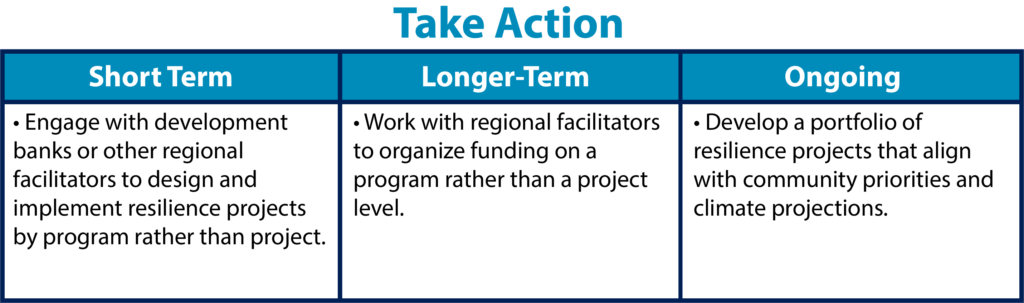
Promising Practices & Innovation
Rhode Island Infrastructure Bank: Pooling Loans Finance Multiple Municipalities' Energy Efficiency Projects
The Rhode Island Infrastructure Bank is tasked, in part, with providing affordable financing for municipal governments to engage in energy efficiency projects. Its calculations showed that at least 10 municipalities would need to join together, creating a portfolio of projects with sufficient size, composition, and diversity to earn a high credit rating for a public bond issuance.
To overcome a lack of standard independent information among local governments with energy efficiency projects, the infrastructure bank used a pool of grant funding to help cover the upfront costs of energy efficiency audits in municipalities. These audits then allowed it to determine the economic value of potential projects for bond investors.[1]
By aggregating multiple municipalities' energy efficiency projects, the bank used a pooled loan approach that created below-market interest rates on the clean energy loans to municipalities. In addition, by mobilizing long-term private capital in the bond market, it provided financing for clean energy projects in more municipalities.[2] Secured by municipal bonds, the infrastructure bank has provided loans for energy efficiency projects in over 30 municipalities across the state.[3]
[1] Green Bank Network, Aggregation and Securitization, https://greenbanknetwork.org/portfolio/aggregation-and-securitization/
[2] Rhode Island Infrastructure Bank (RIIB) “RI Infrastructure Bank Issues First Public Market Green Bond.” 30 November 2018
[3] State of Rhode Island General Treasurer, http://www.treasury.ri.gov › riib
Additional Resources
- The Global Fund for Cities Development's report, Aggregation Interventions to Increase Urban Climate Finance, a knowledge product of the Cities Climate Finance Leadership Alliance, provides a framework for aggregating interventions (including city co-creation platforms) that can increase funding and finance for small and medium-sized climate projects. The report also highlights platforms of aggregation and matchmaking, including CDP Matchmaker, ICLEI TAP, and SDIP. In particular, consider section 2.3: 'Aggregated inputs that increase the pipeline of investable projects and investment vehicles,' beginning on page 32 for aggregation strategies that create enabling environments and increase the ability to invest in urban projects. Section 2.4 (page 42) also offers examples of aggregation at the city level through public procurement.
- Unlocking Green Infrastructure Financing from the State of New Jersey serves as a roadmap for applicants that consolidate information when moving from an initial funding inquiry to final construction expenditures related to green infrastructure. This guide benefits applicants for green infrastructure financing by providing an overview of the financing available from the Water Bank for green infrastructure, clarifying the sequence of required application activities, and defining the standards that must be met at each step along the way. (See page 6 for eligible projects and page 12 for financing details.)
- The Federal Department of Transportation has assembled a project bundling database for six state transportation departments and a county bridge renewal project. This resource offers guidance on the program bundling process that can trigger local level action opportunities and identify existing programs by state. It gathers information on project bundling, including how, why, and by whom. The database was generated as part of the Federal Highway Administration's Every Day Count Five (EDC5) Project Bundling. It contains case studies, contracts, programs, references, and research. Case studies include 12 state transportation departments and some county projects. (More information about case studies at Bridge Bundling Guidebook.)
Characteristic 7: Use comprehensive accounting practices that make a strong business case for action.
What and Why

Ready-to-Fund Resilience Projects take an innovative approach to project accounting practices to make a stronger case and to communicate the benefits they bring to communities in the language that drives financial decision-making: dollar value. The conventional approach to cost-benefit analysis is incompatible with current climate adaptation needs.
- Scope - Traditional Cost-Benefit Analysis (CBA) is infrastructure-centric and lacks a holistic, human focus. It excludes savings in maintenance and operations for assets, replacement costs, and lost opportunities, as well as the holistic social and environmental benefits that accrue after project completion.
- Equity - Traditional CBA considers the value of the asset, which allows higher-priced parcels/assets/systems, etc. to be valued higher than lower-priced assets. Most of these lower-priced assets are owned by LMI and BIPOC people and communities. This means the discounted value in the CBA produces an indirect but very real negative impact on those communities, while wealthier communities receive an indirect positive impact.
- Timeframe - In traditional CBA, immediate needs tend to outweigh longer-term considerations. The benefits of climate resilience investment may take years or even decades to be realized.
Investing in innovative CBA techniques can better equip us to demonstrate that the cost of doing nothing is more expensive than paying for climate adaptation.
How
Many strategies exist to shift how cost-benefit analysis is approached. These strategies help local governments consider and change:
- What is being valued.
- Who is at the table when value is decided.
- Over what time period impacts are taken into account.
- Who benefits and who bears the costs.
Internalize project co-benefits to conduct a triple bottom line (social, environmental, and financial) cost-benefit analysis.
The triple bottom line (otherwise noted as TBL or 3BL) is an accounting framework with three parts: social, environmental (or ecological), and economical. Consider green infrastructure projects, such as wetlands restoration, brownfield remediation, or urban reforestation, that involve a network of “ingredients” for solving urban and climatic challenges by building with nature. In addition to maintaining water quality and mitigating flooding, such installations can clear and cool the atmosphere. This improves public health and lessens basement flooding. Additional improvements are seen in property values and saves owners and renters money. It boosts tourism, which attracts business and produces tax revenue; and it reduces stormwater to treat that lowers public utility costs.[1]
Too often, the dialogue around climate resilience investment only weighs avoided losses against the physical costs of the (gray) infrastructural investment. This conversation usually occurs after disaster strikes. It is essential to highlight proactively that these investments yield a triple dividend because it shifts the focus from the solely upfront project costs to include the cascading benefits over time.
Recently, FEMA incorporated ecosystem benefits into its CBA tool. It is a critical first step toward legitimizing nature-based climate solutions.
Pursue innovative strategies to monetize the "intangible" benefits.
Certain values, such as avoided energy costs, can be determined easily via their market price. However, many values do not have a direct market value - such as the value of social connectivity, costs of trauma, loss of community caused by a hurricane or wildfire, or costs of relocating from one's community.
Seek partnership with local think tanks, groups, and academic institutions to put a value on holistic community co-benefits from resilience investment (as well as the hidden costs of inaction). Contingent valuation and value transfer are two options. See the additional resources section below for insights into how to use these methods in your CBAs.
Correct the misaligned planning horizon of climate resilience investments.
Even if all co-benefits are internalized, the challenge of common discounting practices persists. They are designed to take into account the variable timescales over which costs and benefits are distributed. Traditional discounting practices give very low weight to far-off events, namely the social and environmental benefits of resilience projects. Consequently, by discounting, CBA appears to make these benefits disappear. Engage your CFO to discuss alternatives in this space. See more on discounting alternatives here.
Center Equity.
Traditional CBAs disincentivize equitable climate resilience priorities because they favor present-day returns over avoided future costs and long-term holistic community benefits. With the right standards and incentives in place, these priorities can shift.
Sometimes the most valuable data to inform climate resilience decision-making are numerical/quantifiable. Yet, qualitative data from surveys and community interviews can combine with quantitative data to form more complete and accurate inputs to CBAs. For additional insights into embedding equity into funding and financing processes, review Characteristic 3: Prioritize equity in all project decisions and Characteristic 4: Co-develop climate resilience projects with community residents.
[1] Plastrik, Peter, Joyce Coffee, Scott Bernstein, and John Cleveland. How State Governments Can Help Communities Invest in Climate Resilience, 2020. https://static1.squarespace.com/static/5736713fb654f9749a4f13d8/t/60a41bca20a5810a36ff7977/1621367756587/Coffee+Plastrik+State+Resilience+Framework+September-2020.pdf/.
Think and Act
Ask
- Does the process we use determine who and what we prioritize serve our interests?
- Who decides which outcomes we value?
- What should our criteria be in determining what outcomes we value?
Identify Partners
- Local academic institutions and economic think tanks.
- Financial institutions and innovative investment and engineering firms - such as Quantified Ventures, Naturevest, and Calvert - that have used alternative accounting to support resilience projects.
- Practitioners and consulting firms with experience in bridging the theory and practice of CBA, familiarity with dealing with uncertainty, and bridging the space between the finance world and the day-to-day needs of the municipality, asset owner, or community.
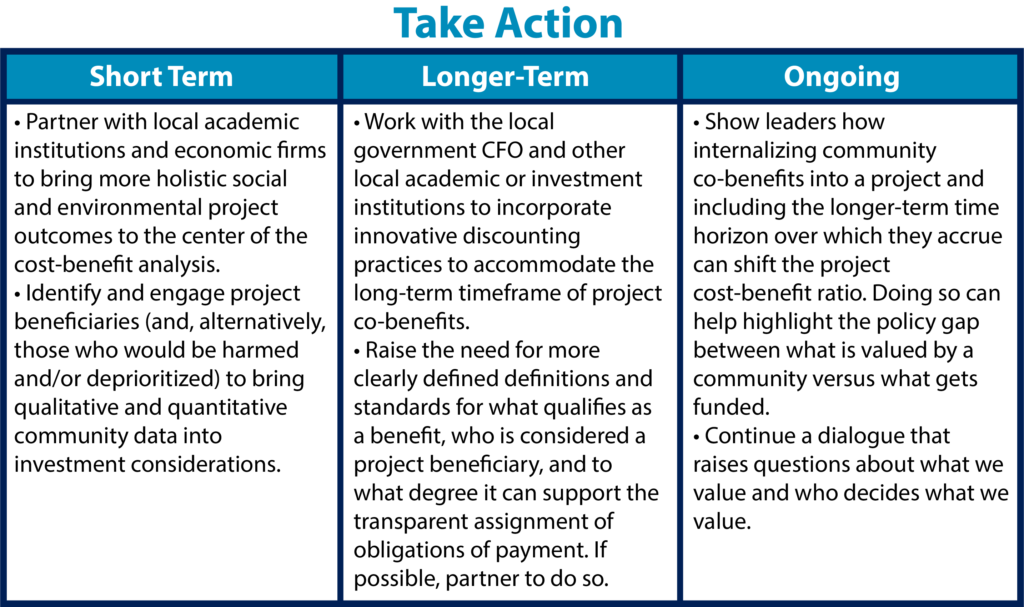
[1]Resilient Nation Partnership Network, FEMA, and NOAA. “Building Alliances for Equitable Resilience,” 2020. https://www.fema.gov/sites/default/files/documents/fema_rnpn_building-alliances-for-equitable-resilience.pdf.
Promising Practices & Innovation
New York, NY: Using Social and Ecological Values to Rethink Project Design.
A seminal example for the use of social and ecological values in rethinking resilience projects is New York City’s (NYC’s) Watershed Protection Program. To meet EPA regulations, traditional water quality practices dictated that NYC construct a water filtration plant costing up to $10 billion in 1997, with annual operating expenses of several hundred million dollars. Facing such an untenable cost, city leaders sought ways to gather EPA waivers for water quality regulations. Officials recognized that instead of building a costly filtration plant, they could preserve and use natural environments to filter city-bound water. They embarked on a plan to pay for watershed management and regulation best practices in upstream communities. Land acquisitions, management programs, and other initiatives have since cost over $2.5 billion. Additionally, the program has spent over $270 million toward partnership programs in the first 10-to-15 years to realize mutually beneficial outcomes for small and rural upstream communities that undertake watershed management practices. In total, this program not only sharply undercut the initial $10 billion cost of building a new filtration plant, but also provided natural habitats, tourism, sustainable agriculture, and natural water quality filtration benefits for the region.
Additional Resources
- The National Institute of Science and Technology (NIST) Economic Decisions Guide summarizes the CBA process, and the accompanying Community Resilience Economic Decision Guide for Buildings and Infrastructure Systems provides more detail (pages 15-30 in particular).
- The 2019 Mitigation Saves Report from the National Institute of Building Sciences includes cost-benefit ratios for various risk mitigation strategies, ranging from adopting international building codes to undertaking private sector building retrofits. For details, see page 2.
- Headwater Economics Report, How communities reduce flood risk: Five midwestern case studies, highlights success stories from Austin, MN; Fargo, ND; Grand Island and Lincoln, NB; and Tulsa, OK. They showcase strategies of local and regional leaders to strengthen their communities and reduce flood risk. Together, these stories shed light on the range of solutions communities can employ to fund and execute projects that protect people and property from damaging floods.
- NOAA’s Guide to Assessing Green Infrastructure Costs and Benefits for Flood Reduction offers a six-step framework to inform planning-scale assessments and spark discussion about green infrastructure options to mitigate flooding and provide other watershed benefits. This guidance includes how to estimate associated costs and benefits over a chosen planning horizon and demonstrate cost-effectiveness.
Measuring social and ecological co-benefits.
- Ganderton’s ‘Benefit-Cost Analysis of Disaster Mitigation: Application as a Policy and Decision-Making Tool’ provides an overview of the CBA process and discusses the various alternative methods to measure (non-market) value.
- ‘Environmental Cost-Benefit Analysis’ by Giles Atkinson and Susana Mourato focuses on monetizing environmental services.
Correcting for the misaligned timeframe.
- The Manchester Metropolitan University CBA Toolkit details ways to account for a longer-term payback period in CBA.
- The European Commission Cost-Benefit Analysis of Investment Projects, especially Chapter 2 (page 25), offers a guide to CBA and accounts for the ‘longer-term perspective’ of project benefits.
- The National Academies of Science’s Guidebook on Incorporating the Costs and Benefits of Adaptation Measures in Preparation for Extreme Weather Events and Climate Change, including Chapter 2 (page 6), provides a thorough analysis of the process, including how to handle a longer-term payback period.
Centering Equity.
- C40 Cities - The Co-Benefits of Sustainable City Projects delivers information on alternative analysis methods to CBA.
Online CBA Software Tools by project type.
- General
- FEMA CBA Toolkit - An online software tool that quantifies costs and benefits for a range of major natural hazards and project types, including flood, tornado, hurricane wind, earthquake, wildfire, drought, and landslides. The accompanying user guide navigates the platform. This tool is best for users familiar with the FEMA BCA system. While it can quantify the extent to which hazard mitigation measures may reduce injuries, loss of life, hardship, or the risk of future damage and destruction of property, the tool lacks a holistic approach and does not consider other social and environmental factors. More information is available in the FEMA Report on Costs and Benefits of Natural Hazard Mitigation.
- Power projects
- The FEMA CBA tool integrates “damage costs of increased injuries and lives lost from degraded critical services during power interruptions.”
- NREL’s REopt model offers resources to evaluate Distributed Energy Technologies.
- The Interruption Cost Estimate (ICE Calculator) developed by Lawrence Berkeley National Laboratory tool can help estimate power interruption costs and related reliability benefits.
- Green infrastructure projects
- A Green Roof Energy Calculator developed by the Green Building Research Laboratory allows any building owner to estimate potential energy savings.
- AutoDesk Triple Bottom Line Analysis Tool, available via subscription, analyzes civil infrastructure project design for such factors as public benefits of improved water quality, and increased recreational and property value.
- Heat projects
- The City of Phoenix’s method for monetizing lost or productivity (morbidity) from the Heat Island Effect.
- Air quality projects
- Models to quantity ecosystem services: iTree, inVest, and biome-BGC.
- BenMAP: software that estimates the health impacts and economic value of changes in air quality.
Characteristic 8: Ground project processes and outcomes in climate resilience metrics.
What and Why

Ready-to-Fund Resilience Projects use climate resilience metrics to attract investors by illustrating project potential, measuring project progress, and demonstrating project success. Integrating resilience metrics into your approach to resilience funding and finance can:
- Foster an environment and means for ensuring accountability to project outcomes.
- Align goals across government departments.
- Enable resilience project leaders to show the value of resilience projects that generate greater buy-in from potential funders.
- Illustrate project prioritization.
- Presents tangible change that is a hopeful and mobilizing alternative to risk messaging.
- Build political will and support powerful stories of progress and success.
There is not a standard set of climate resilience metrics. Each community must monitor and evaluate climate resilience progress in a way that’s specific to the community’s context and depends on factors such as geography, policy environment, and desired community outcomes. Nonetheless, funding and finance entities are beginning to require municipalities to monitor and evaluate various components of the resilience-building process, predominately how it is mitigating risk. Establishing a context-specific framework for resilience metrics in your community is increasingly important for eligibility and proof of concept.
How
The Resilience Metrics Toolkit offers a framework to support the process of identifying and using metrics to evaluate progress. The steps below are a distillation of the information contained in the Resilience Metrics Toolkit.
- Bound and Assess Context- Defining and bounding an issue or problem clarifies the scope of your adaptation effort, which is a critical foundation for success at subsequent steps in the process. Key considerations include:
- Current problems.
- Current or likely future opportunities.
- Information gaps, especially those related to risk, vulnerability, and assets; i.e., What is known and what isn’t about current conditions, future risk, and vulnerabilities?
- Decision context: Who are the relevant decision-making bodies, individual actors, and/or jurisdictions that should be involved?
- Stakeholders: Who should be at the table in this adaptation effort?
- Vision Success- To gauge success in your adaptation efforts requires knowing what “success” means to the stakeholders involved in those efforts. Partner with community organizations to develop a clear and pragmatic vision of community climate resilience that aligns with your city's priorities. Developing a common vision builds political will and engages the public. It also provides a motivational focal point for orienting your metrics strategy. For more guidance on developing a vision for climate resilience in your community, see Characteristic 2: Get buy-in from community and government leaders in positions of power.
- Explore and Identify Indicators- An indicator is defined as "a quality, trait, or state of a system that suggests ("indicates") or hints at something one is interested in. More specifically, an indicator is a sign that a particular set of adaptation actions are yielding the desired result and/or making progress in the right direction. Examples of indicators might include reduced damage to homes from flooding or uninterrupted food supply for all residents during storms."
- A metric, on the other hand, is a “variable that can be measured (if quantitative) or otherwise tracked (if qualitative) that represents the indicator.”[1]
- When people are eager to measure progress and success, they may be tempted to jump right to concrete metrics. Often these metrics are based on data convenient to collect or obtain. Sometimes, the proposed metrics are those everyone else tracks, or they seem simple and intuitive. Instead, begin by brainstorming indicators and use this framing to guide your choice of metrics. - Select Indicators and Identify Metrics- It is critical to integrate a diversity of holistic metrics and performance indicators for all stages of the resilience-building process -from planning, project prioritization and execution, and ongoing monitoring and maintenance. These metrics can help prioritize investments in line with the greatest risks, monitor resilience progress, and evaluate the effectiveness of investments or programs. Assessing the diversity of metrics that address the implementation process, building adaptive capacity, and outcomes for agencies and communities holds us accountable to holistic resilience building, not just a sliver of the story.
According to the Resilience Metrics Toolkit, measures of adaptation success for a community, region, or organization requires investigating six dimensions. These categories can serve as a guiding framework to ensure consideration of a diversity of metrics.[2]
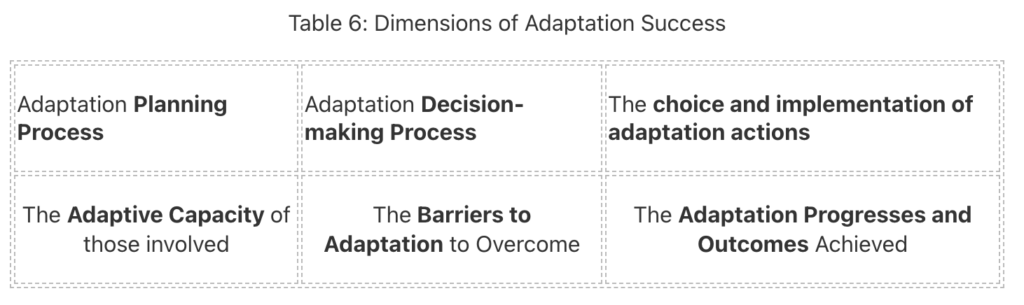
Monitor Indicators and Metrics- Implementing resilience metrics is all about drawing a line between a current problem and where your community wants to be in the future and then setting metrics that orient strategies to hold up against such stressors as COVID-19 or climate impacts. Resilience metrics should serve as guide rails, informing decision-makers of the direction required to realize their resilience vision, progress being made, and the course corrections necessary when needed. To secure capacity and resources for this continuous reassessment, ensure that ongoing monitoring lies within your scope for funding and finance.
[1] Resilience Metrics. “Exploring & Identifying Indicators,” n.d. https://resiliencemetrics.org/indicators-metrics/exploring-identifyin
[2] Resilience Metrics. “Key Dimensions of Adaptation Success,” n.d. https://resiliencemetrics.org/dimensions.
Think and Act
Ask
- How do we define resilience 'success’ in our communities?
- What local government process are we trying to shift, and how can we track progress?
Identify Partners
- Academic institutions
- State resilience offices
- Stormwater and energy utilities
- Impact investment firms
- Local businesses
- Community-based organizations working toward resilience, economic development, or improved health outcomes
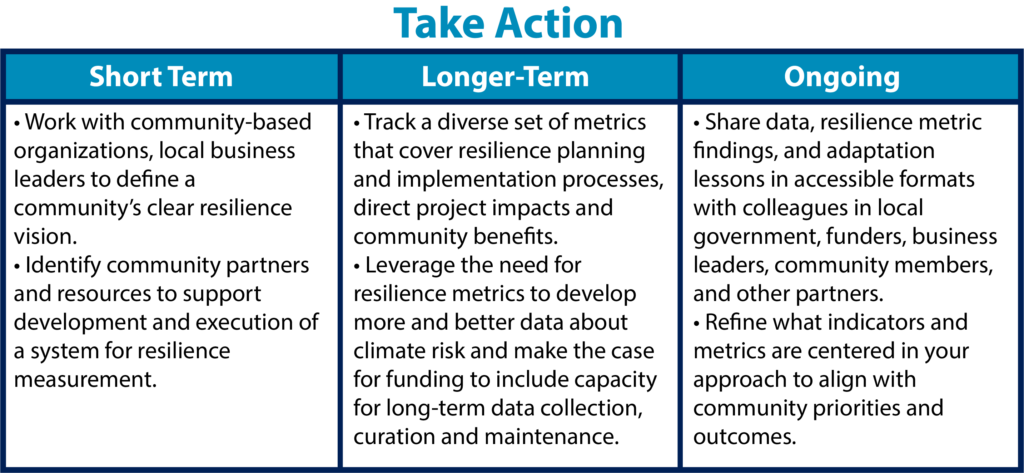
Promising Practices & Innovation
Wheat Ridge, CO: Evaluating Success Alongside Community Priorities.
Since 2013, the City of Wheat Ridge, Colorado, has grounded its programs and annual budget by the metrics of its Priority-Based Budgeting program. Every year, city officials evaluate the previous year’s programming against the voiced goals of their community. Rather than just revise the previous year’s budget, officials evaluate programs based on a list of different metrics, including program costs, impact, effectiveness, and year-to-year variances. They then compare these metrics to community priorities. This metric-based approach for setting priorities allows the city to save money and invest in, preserve, and enhance those services the community values most. In 2018, this process translated into a $657,000 decrease in departmental budget costs, allowing the city to fund critical programs and resilience measures. Wheat Ridge sees large returns on investment in this process year after year while avoiding the displacement of important programs, especially when budgets are tight.
NAACP: Embedding Equity in Resilience Metrics
Identifying frontline communities for priority projects provides a key prerequisite to an equitable resilience funding process. The NAACP has identified pre-existing indicators of disproportionate exposure to climate risks. They capture the potential for compounding and accumulating risks and exposures. They include air quality, homes within a 10-mile radius of a hazardous facility or toxic site (including brownfields), and households with electricity and/or water shut-offs in the last 12 months.
Additional Resources
- Resiliencemetrics.org offers a guiding framework for how to align resilience metrics to your unique municipal situation, explore and identify indicators, and track indicators and metrics. In addition, the site offers suggested indicators to consider in these categories:
- Economic Indicators
- Environmental Indicators
- Governance Indicators
- Infrastructure Indicators
- Social Indicators
- The United Nations Office for Disaster Risk Reduction (UNDRR) provides several resources that frame resilience metrics relating to public health and the built environment:
- Public Health Addendum: Aims to strengthen and integrate coverage of the many aspects of public health issues and consequences of disasters not adequately emphasized in the original Disaster Resilience Scorecard for Cities ("the Scorecard"). While the more obvious health factors such as hospital service capacities and structural and nonstructural safety are covered in the Scorecard (under Essential 8), other disaster-related public health issues haven’t been well addressed. The Addendum should be used in conjunction with the UNDRR Scorecard and WHO’s Health Emergency and Disaster Risk Management (Health EDRM) Framework.
- Building Scorecard: Enables the establishment of a baseline for the resilience of buildings and campuses to natural hazards or man-made disasters, allowing improvements to be identified and prioritized. The Building Scorecard is intended for use by the owners, managers, and operators of commercial, industrial and multi-residential buildings or campuses, both government- and privately-owned.[1]
[1] Dillard, Maria. “Inventory of Community Resilience Indicators & Assessment Frameworks.” National Institute of Standards and Technology, April 16, 2021. https://doi.org/10.18434/MDS2-2297.
Characteristic 9: Clearly connect to local government plans.
What and Why

Ready-to-Fund Resilience Projects are grounded within existing community plans that articulate a long-term pipeline of projects. Grounding climate resilience projects within existing community plans can help secure funding and finance by:
- Offering more certainty and less risk to entice investors.
- Helping local government leaders and partners better identify and act on synergies between projects to pool resources and share costs among them.
- Addressing questions that credit rating agencies or investors may have, driven by the Task Force on Climate Related Financial Disclosure,[1] which provides guidelines for consistent climate-related financial risk disclosures (both physical climate impact risks and transition from fossil fuel risks) for use by investors.
[1] Task Force on Climate-Related Financial Disclosures. “Task Force on Climate-Related Financial Disclosures | TCFD),” n.d. https://www.fsb-tcfd.org/.
How
Below are strategies for connecting climate resilience projects to local government plans. Characteristic 10: Benefit from policies that incentivize climate resilience action describes policies that can support and incentivize implementing these strategies.
Mainstream climate resilience.
Climate resilience should be integrated into all local government plans, policies, programs, and investment decisions rather than an "add on" cost or feature. While creating new funding streams for climate resilience projects is necessary in some cases, mainstreaming climate resilience into all project types is an important strategy that can help avoid unhelpful distinctions between "resilience" and "non-resilience" projects.
Ensure plans and projects address long-term climate impacts.
Long-term planning provides a framework to assess long-term climate risk and the impetus to design projects in a durable and flexible manner to withstand changing climate conditions. For example, nature-based solutions need to use species that will thrive in a location's future climate. Coastal projects, in particular, must seriously consider the potential for community relocation and, therefore, the investment’s likely true lifespan.
Break down silos for integrated climate resilience planning.
As discussed in Characteristic 1: Use cross-sector partnerships to increase project capacity, Ready-to-Fund resilience projects integrate capacity and goals from across local government agencies and departments. The same goes for effective climate resilience planning - plans should reach across many areas of the local government to holistically address interconnected issues.
Connect with political planning and vision.
Connecting with local government planning and vision is key to achieving long-term support and commitment, particularly from those who hold positions of power and may possess veto power. Private-sector interest also requires a high degree of certainty that projects will proceed and receive political reinforcement. This means incorporating resilience into long-term infrastructure pipelines via bankable projects that are economically, socially, and environmentally sustainable. These plans must have clear project outcomes, a timeline, and transparency.
Look beyond hazard mitigation planning.
While Hazard Mitigation Plans are a prerequisite for highly sought-after FEMA funding, it is necessary to look beyond hazard mitigation when considering what types of plans should ground climate resilience projects. For example, the 2021 Infrastructure, Investment, and Jobs Act (IIJA) sets aside $47 billion specifically for climate resilience but has many billions more available for investments in resilience-relevant areas. Local governments can use this funding for climate resilience projects, but will be most effective in obtaining it and investing it in a way that meets climate resilience goals if they have sound plans in place to ground projects in that area and if they develop those plans with climate resilience criteria and priorities at the center.
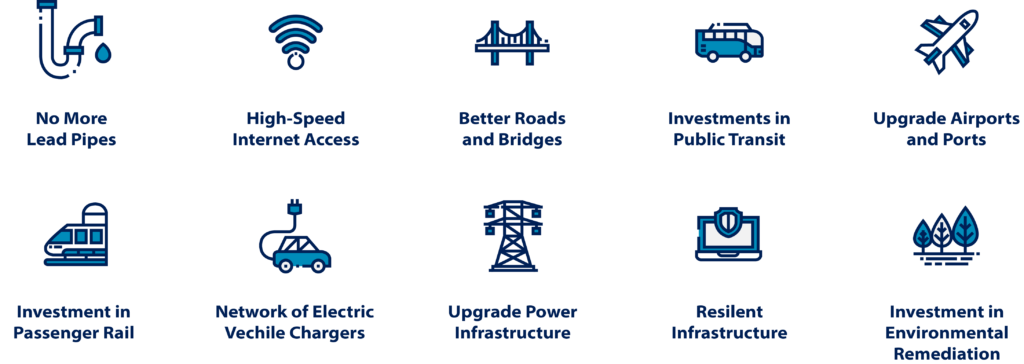
Think and Act
Ask
- How do our local government’s plans, both short- and long-term, reflect the community’s climate resilience goals?
Identify Partners
- Internal local government partners across agencies and departments.
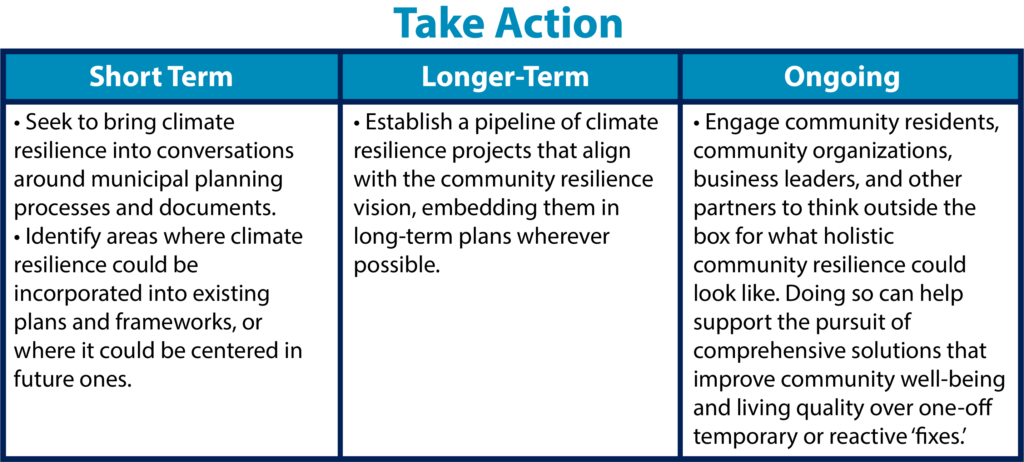
Promising Practices & Innovation
Boston, MA: Integrating Climate Considerations Into a Natural Hazard Mitigation Plan.
In 2021, Boston began updating its Natural Hazard Mitigation Plan (NHMP), a requirement for funding through the Federal Emergency Management Agency (FEMA). A steering committee of city leaders focused on the vulnerability and risks associated with natural hazards using past events to inform future planning. However, previous planning initiatives and studies of the city showed officials that climate change could exacerbate the vulnerability and risks of possible future hazards. Thus, in addition to data on historic events, climate change scenarios and estimates were considered for such issues as rising heat, increased precipitation and flooding, and sea-level rise and coastal surge. The list of the city’s hazard mitigation recommendations included certain climate adaptation solutions, such as energy resilience measures and raised building features along the coast. In addition to a more holistically developed plan for protecting residents, the incorporation of climate adaptation into the NHMP also opened the doorway to more funding sources beyond FEMA grants, including Massachusetts’ Municipal Vulnerability Preparedness grant program.
Additional Resources
- The United Nations Office for Disaster Risk Reduction (UNDRR) offers several resources that can assist with resilience planning, including the Scorecard for Cities. The Scorecard provides a set of assessments that allow local governments to assess their disaster resilience, structuring around UNDRR’s Ten Essentials for Making Cities Resilient. It also helps to monitor and review progress and challenges in implementing the Sendai Framework for Disaster Risk Reduction: 2015-2030 and supports the baseline analysis for preparation of the disaster risk-reduction and resilience strategies. When considering risk, the Quick Risk Estimation tool (QRE) developed by UNDRR and Deloitte can be useful.
- Cities Advancing Climate Action: Leveraging Federal Funds for Local Impact A Resource Guide prepared for by the Alliance for a Sustainable Future, is an inspiration and a practical guide for cities at the center of advancing climate and resilience priorities for communities that are in a position to make an even greater impact in their communities. With funding from the Infrastructure Investment and Jobs Act (IIJA), the Alliance for a Sustainable Future, a collaboration between The U.S. Conference of Mayors (USCM) and the Center for Climate and Energy Solutions (C2ES), has developed a collection of case studies that highlight what cities can do now to preposition for funding, plan for co-leveraging diverse funds, and develop projects to capture maximum community benefits.
Characteristic 10: Benefit from policies that incentivize climate resilience action.
What and Why

Ready-to-Fund Resilience Projects benefit from policies that incentivize or mandate equitable climate resilience investment, such as standards and codes that enforce climate resilience criteria, mandatory risk assessments, or tax incentives for investments that prioritize LMI and BIPOC communities. Policies can have far-reaching impacts on a local government’s ability to design projects that are Ready-to-Fund; effective and equitable policies to incentivize or mandate equitable climate resilience investment can:
- Increase certainty for investors.
- Reduce transaction costs and improve efficiency.
- Increase local government creditworthiness, increase eligibility for funding, and unlock additional funding streams.
- Enhance transparency.
- Mitigate risk, avoid losses, increase resilience, and promote equitable project outcomes.
- Set a framework for collecting data to monitor metrics of success.
How
Bake risks into institutional framework and policies.
The more robust and structured a regulatory framework and the more efficiently it is enforced by independent regulators, the greater the likelihood that prospective investors will help fund projects. The following actions support baking risks into institutional frameworks and policies:
- Mandating risk assessments.
- Integrating future climate information into land-use planning and other decision-making. For infrastructure, this means incorporating climate risk considerations across the entire asset lifecycle.
- Adopting disclosure requirements that steer investors toward projects and institutions exposed to less climate (and thus financial) risk.
- Clarifying public/private risk allocations and codifying allocations through legally enforceable contacts.
- Introducing climate risk considerations into disclosure requirements and fiduciary responsibility standards.
- Expanding access to price guarantees in resiliency benefits to help overcome the policy sensitivity of these investments, reducing risk for private investors.
- Encouraging banks to set aside a certain proportion of existing guarantees for projects that meet sustainability criteria to boost investment of private capital.
In addition to addressing risks through institutional frameworks and policies, local governments benefit from mitigating and managing risk in their overall approach to funding and finance and on a project-by-project basis. Risk Management Mechanisms introduces financial mechanisms that manage risk and encourage private sector investment.
Establish equitable resilience standards and incentives.
Standards and codes are critical for public infrastructure, buildings, and utilities as well as for regulatory mechanisms to build climate resilience on private property. Establishing standards also enhances eligibility for federal funding. For instance, FEMA’s Building Resilient Infrastructure for Communities grant program awards significant points to states with such elements as a state building code in place. Below is a sample list of actions to support equitable resilience standards and incentives that a local government could consider implementing or supporting:
- Integrate climate resilience measures into program spending and evaluation criteria.
- Incorporating climate adaptation and resilience standards into existing funding streams could ensure that all projects and programs account for climate risks and include adaptive components. In many cases, this approach will be easier to execute than creating new funding streams that require broad administrative, political, and public support. Adapting the standards of existing funding tools to include clear, measurable, and consistent criteria for evaluating and comparing project risks could help reduce the burden of understanding the vulnerabilities of projects to climate risks. It also could direct existing resources to support projects that minimize climate change exposure and limit the need for future costly interventions that may be required when climate change exposure is not considered.[1]
- Incorporate resilience criteria into public/private partnership RFPs.
- This signals to investors that demand exists for resilient infrastructure and it’s in their interest to learn how to evaluate it. It makes it easier and more cost-effective for others - local governments or private companies – to demand similar standards. Moreover, contractors, architects, and project managers will have to develop resilience-related capabilities to win public contracts.[2]
- Increase market incentives (such as insurance discounts) for projects that increase resilience.
- Create tax or credit incentives for projects that prioritize lower-income and BIPOC communities.
Support Structural Shifts
Ultimately, local governments are limited in their ability to seek transformational change. Many challenging practices and policies that may inhibit climate resilience momentum stem from top-down practice. The above included many strategies to better operate within existing policy structures. However, resilience leaders and technical assistance providers, especially as a collective, hold the power to structurally influence the policy environment itself. By partnering with advocacy groups and elected officials, resilience leaders can lobby for better state or federal policy. See a full list of Policy Levers to incentivize equitable climate resilience investment here.
See Characteristic 1: Use multi-scale, cross-sector partnerships to increase project capacity for additional ideas about coalition-building.
[1] Smith, Kris. "Building Funding Strategies for Flood Mitigation Projects." Headwaters Economics. September 09, 2021. https://headwaterseconomics.org/natural-hazards/funding-strategies-flood-mitigation/#how.
[2] McKinsey mobilizing private sector finance for sustainable infrastructure.
Think and Act
Ask
- How is everyday decision-making based on public policy supporting equitable resilience funding and finance?
- How can we mitigate risk to attract greater investment in equitable climate resilience?
- Are the conditions and processes in place for investors to assess the resilience of investments?
- What policies are preventing resilience investments?
Identify Partners
- Local government practitioners.
- Organizations that support municipal policy.
- State and federal agencies with power and influence over resilience funding and finance and associated policy.
- Institutional investors.
- Agencies and departments across the local government.
- Local think tanks and economic institutions.
- State and national data providers.
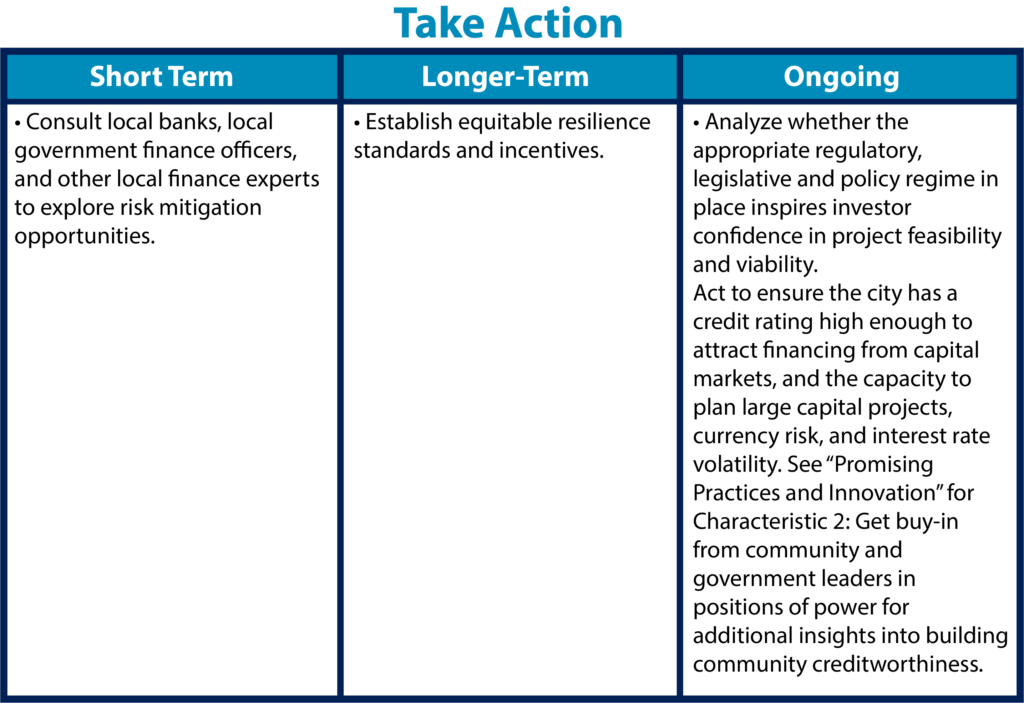
Promising Practices & Innovation
Los Angeles, CA: Establishing Incentives to Combat Heat.
Like many other U.S. cities, Los Angeles faces a heat problem. Exacerbated by asphalt and other building materials, heat within the city led to increasing heatstroke deaths from 2014-2018. The city had tried to enact various climate resilience measures, such as a Cool Roofs Ordinance in 2014 and a “Save Energy LA” campaign in 2016. However, the city in 2018 added an ambitious five-year insulation rebate program to counter this problem. The Los Angeles Department of Water and Power would provide homeowners between 20-30 cents per square foot of roofing retrofitted to cooler roofing materials. Not only would this decrease surrounding temperatures during hot days, but cooler roofs would also reduce the use of air conditioning consumption as well as airborne pollutants. This incentive program encouraged tens of thousands of residents and building developers to convert their roofs. More than 3.6 GWh/yr has been saved in energy consumption through these cooler roofs, and heat-related deaths declined nearly in half in 2019 from 2018.
Mitigating Risk via Private Sector Involvement
When governments risk-share with the private sector, risk retained by the Government in owning and operating infrastructure is allocated partially to a private party that can better manage it. This can reduce the project’s overall cost to the government.[1]
Local government resilience leaders, needing to cope with budget constraints and other factors, may have difficulty centralizing risk in project considerations. When risks do emerge, they typically do not trigger major fiscal consequences. Governments seldom face liquidity problems, and the failure of a single project typically will not affect a government’s credit rating. However, climate-specific risks trigger a new dimension of risk. In contrast to construction delays and cost overruns, benefits take longer to appear, may face significant and continuous disruption, and may never appear.[2]
By contrast, in the private sector, construction and commercial risks can have massive financial consequences. A 10% cost overrun can mean the company no longer earns profit on a specific initiative, or could even bankrupt an organization. Consequently, the private sector has become experts in risk management across a project’s lifecycle. The private sector doesn't just assume risk; it actively manages it, prices it, and determines the compensation required to take it on.
When involved in public resilience projects from the outset, the private sector considers all risks, including climate risks, construction risks, and commercial risks after completion, among others. In addition to the baseline costs required to deliver a project, the developer adds a risk premium to cover the additional measures and activities required to mitigate and manage these risks.[3] Along with supporting predictability, transparency, whole-of-life management, cost savings, and accountability, government payments are conditional on the private party providing the specified outputs at the agreed quality, quantity, and timeframe. If performance requirements are not met, service payments may be abated.[4]
In an ideal partnership, the private sector provides risk management skills and benefits from the public sector's ability to take a long-term view and interest and absorb other risks without the fear of bankruptcy.
[1, 3, and 4] Resilient Nation Partnership Network, FEMA, and NOAA. “Building Alliances for Equitable Resilience,” 2020. https://www.fema.gov/sites/default/files/documents/fema_rnpn_building-alliances-for-equitable-resilience.pdf.
[2] PWC and Global Infrastructure Facility. Increasing Private Sector Investment into Sustainable City Infrastructure, Oct. 2019, https://www.pwc.com/gx/en/industries/assets/pwc-increasing-private-sector-investment-into-sustainable-city-infrastructure.pdf.
Quick References
Policy Incentives
Policy actions to incentivize equitable climate resilience investment.
Expand to see policy incentives.
| Impact | Sample Policy Actions |
|---|---|
| Establishing Criteria for Equitable Climate Resilience | [1] Integrate climate resilience measures into program spending and evaluation criteria. [2] Incorporate resilience criteria into public/private partnership RFPs. [3] Integrate resilience requirements and design principles into all infrastructure-related policies, programs, and investment decisions. [4] Increase market incentives (such as insurance discounts) for projects that increase resilience. [5] Establish tax or credit incentives for projects that prioritize LMI and BIPOC communities. |
| Baking Climate Risk into Institutional Frameworks | [1] Mandatory risk assessments. [2] Integrate future climate information into land-use planning and other decision-making, and take into account climate impacts that gravely impact communities, particularly those historically marginalized by land-use decisions. For infrastructure, this means incorporating climate risk considerations across the entire asset lifecycle. [3] Adopt disclosure requirements that steer investors toward projects and institutions exposed to less climate (and thus financial) risk. [4] Clarify public/private risk allocations and codify allocations through legally enforceable contacts. [5] Introduce climate risk considerations into disclosure requirements and fiduciary responsibility standards. [6] Expand access to price guarantees in resiliency benefits to help overcome the policy sensitivity of these investments, reducing risk for private investors. [7] Encourage banks to set aside a certain proportion of existing guarantees for projects that meet sustainability criteria to boost investment of private capital. |
| Standardizing Climate Resilience Investment Processes | [1] Standardize procurement and contractual processes that include climate resilience to minimize transaction costs for the private and government sectors, but with sufficient flexibility built in for project/sector-specific requirements. [2] Ensure objective, robust local government governance procedures and vehicles to serve as a focal point for investors to partner with. [3] Create policy platforms to enable cooperation among developers, investors, and regulators. [4] Standardize bidding and procurement processes. [5] Develop clear and consistent investment regulations and policies. [6] Build a strong institutional framework that clearly articulates roles and distinct responsibilities between the public and private sectors. [7] Build capacity to advance project development in a more streamlined and cohesive manner. |
| Supporting Innovation | [1] Establish common legal and design standards that can reduce costs and make doing business easier. [2] Pass policy that provides approval of innovative financing mechanisms and models. |
Risk Management Mechanisms
Implementing risk-reduction measures is critical to obtaining private sector investment. The table below describes financial mechanisms to manage risk that can increase investor comfort and interest while often simultaneously lowering costs.
Expand to see risk management mechanisms.
| Financial Mechanism | Enabling Policy Environment |
|---|---|
| Financial Mechanism Enabling Policy Environment Green bonds and Yieldcos | Instruments such as green bonds and yieldcos use common financial instruments that give investors a sense of familiarity and, thus, security to enhance capital flows to resilient infrastructure. Investors view green bonds as an increasingly common type of revenue bond and a good way to achieve market-competitive returns while incorporating climate change as part of their institutional missions. Yieldcos are publicly traded companies created by a parent company that bundle operating infrastructure assets to generate predictable cash flows that are then paid out in shareholder dividends. Green bonds and yieldcos can reduce risks associated with infrastructure investments. For instance, the credit risk associated with green bonds is typically lower than that of similar project bonds because the risk is assumed by the issuing entity and not by the cash flows from the individual project. Yieldcos, or a ‘yield’ company formed to own operating assets and raise funds by issuing shares to investors, reduce risk by pooling projects, which helps institutions diversify their investments. |
| Adapting financing models | Another option is to adapt existing funding models to seek innovative risk-transferring mechanisms while operating within a framework familiar to investors. “Land value capture,” for example, is used to finance railways, metros, and highways. This model seeks to capture the additional value created by infrastructure through impact fees, special assessment districts, or tax-increment financing. This allows infrastructure to be financed based on its ability to raise the value of the surrounding land once built. Similar models could be designed for resilient infrastructure, if it made a community safer from flooding and increased property values. This value, for instance, could be leveraged to finance the up-front project investment.[1] Over the long run, the more experience institutional investors gain with resilient projects, the more comfortable they will be and more likely to allocate more of their portfolios to resilient infrastructure.[2] |
| Guarantees | A guarantee is a commitment signed with a financial institution (bank, insurance company, city, etc…) that “covers the beneficiary in case of default or breach of a contractual obligation.”[3] So long as climate risk is baked into project planning and implementation considerations, guarantees provide an effective way to “crowd in” private finance and leverage multiples of private capital for every dollar spent.[4] Guarantees make it possible for risk-averse investors to participate in a project they might otherwise avoid. As investors see that the real risk profile is lower than they believed, guarantees would no longer be required. Increasing the use of guarantees can be achieved in numerous ways, although a primary strategy involves differential pricing. While policy risk could be higher, resilient infrastructure should be less vulnerable to climate risk than traditional infrastructure, lowering an investment’s long-term risk profile. Therefore, some guarantees for resilient infrastructure could be priced lower than those for traditional infrastructure. Differential pricing also could provide an incentive to the private sector to invest in resilient infrastructure, particularly if backed by guarantees. Increasing guarantees is relatively simple in terms of policy and execution. It involves scaling up existing capabilities. Stakeholder coordination also is straightforward because it only requires banks to modify what they are doing and place a greater emphasis on resilient infrastructure. However, in many cases, governments also must agree to provide a counter-guarantee, something they may be unwilling to do. Also, there may be an insufficient number of projects that want guarantees or that meet development banks’ requirements. |
| Syndication loans | A syndicated loan is: “Financing offered by a group of lenders—referred to as a syndicate—who work together to provide funds for a single borrower. The borrower can be a corporation, a large project, or a sovereign government. The loan can involve a fixed amount of funds, a credit line, or a combination of the two.”[5] Using a syndication can create a larger secondary market for resilient infrastructure-related securities. Loan syndication enables lenders to recycle their capital for more resilient infrastructure investment, increasing the projects financed. This would boost institutional investor familiarity with the asset class, reduce transaction costs, and allow the recycling of capital. Loan syndication also reduces transaction costs. This is particularly helpful for smaller projects and those that require a premium or that include new technologies. By providing a lower-risk, lower-cost way to participate, syndication gets the private sector involved, building its confidence and willingness to invest.[6] |
| Insurance pooling | A ‘risk pool’ is a form of risk management mostly practiced by insurance companies. They unite to form a pool to provide protection against catastrophic risks such as floods or hurricanes. Take wind pools, for example. Coastal wind insurance pools in the U.S. are chartered by states to provide property insurance to residents and businesses that cannot secure private insurance with sufficient coverage at rates considered affordable. Some "wind pools" cover only wind losses, while others offer a multi-peril policy. Indeed, multiple pools can coexist in the same state. Rates vary by pool, region, and policy type, and they often are below actuarially sound levels. Wind pools in states along the Atlantic Coast have grown in recent years—sometimes dramatically—yet few have enough capital (either retained or by way of reinsurance) to satisfy their potential obligations. Risk pools in the form of parametric insurance are being improved to include natural resource conservation, such as coral reefs. |
Financing Mechanisms
Local governments have access to many funding mechanisms to further resilience progress. To supplement federal, state, philanthropic, and institutional grants, these are several mechanisms available to leverage debt, seek innovative sources of revenue, engage the private sector, and mitigate risk.
Leverage debt to grow funding and finance.
| General Obligation Bonds | A common municipal bond structure issued by a local government (secured by an income or carbon tax) to finance major infrastructure and other resilience investments that provide long-term public benefits. Bonds are sold to investors by municipalities (or states) and secured by the available revenue streams (taxes). Low transaction costs, relatively well understood, does not require new legislation. |
| Revenue Bonds | Similar to general obligation bonds except the revenue source backing the bond and paying the debt service is the project being financed. For example, a highway can be financed with a revenue bond if tolls collected are used as debt service. |
| Green Bonds | Loan for a fixed period of time that goes toward environmental projects and is often associated with tax incentives. Traditionally, they are very infrastructure-centric and less useful to further more holistic, human-centric resilience efforts. They have been used to raise capital for specific clean power, carbon-reducing projects. However, green bonds increasingly are used to finance non-carbon projects, including stormwater management, transportation, land-use projects, and waste management, among others. More appealing than bank loans, they offer longer maturity periods, third-party credit enhancement and more flexible covenants. When issued by government entities, they are tax-exempt. |
| Resilience Bonds | An experimental finance mechanism not yet in the marketplace, they are a variation of catastrophe bonds that link insurance and resilience projects to monetize avoided losses (reduction of insurance claims). The resulting risk-reduction “resilience rebates” can be a source of predictable funding for insurance policyholders to invest in as a means to finance resilience projects. |
| Catastrophe Bonds | Catastrophe bonds provide a means to manage financial risk associated with extreme natural disasters. Essentially, they are a form of insurance and trigger when disaster strikes. When a disaster (hurricane, storm surge, flood, earthquake, etc.) reaches a given threshold within the bond term of 3-5 years typically, the insurance purchaser keeps a certain amount of the bond to pay off losses and investors lose some or all of their investment. They prove attractive to investors because they are not associated with other financial risks and provide attractive rates of return. They become more valuable investments when the estimate of financial loss from a natural hazard shrinks. They are used regularly by government-sponsored insurance programs, including the California Earthquake Authority, Florida Citizens Property Insurance, Louisiana Citizens Insurance, Amtrak, and the Texas Windstorm Insurance Association. |
| Tax Incremental Financing | Tax Increment Financing (TIF) is a method of financing a project or development in a designated geographic area and based on the anticipated increase in property tax generated by the project. TIFs offer a promising mechanism to promote investment in climate resilience and nature-based solutions so long as the property costs are not borne by LMI or BIPOC residents or property owners and improvements do not displace local businesses and residents.[1] |
Generate revenue specifically for resilience.
| Utility Rates | A traditional approach to generating revenue that taps utility revenues by adjusting rates. Use of these funds is restricted to actions consistent with the utility’s purpose. With electric utilities, this can be done through rate-setting by state regulators. Stormwater utilities around the U.S. have been raising rates to pay for flood-prevention improvements. An advantage of using bonds and utility rates is that they spread the costs across very large numbers of payers, which allows the increases to be minimized. But this spread also means the benefits of resilience building that may be realized are not tied to the costs that one will pay. |
|---|---|
| Insurance Surcharges | A state or regional trust fund, capitalized via a surcharge on certain lines of insurance (such as property, casualty, for example) can offer an additional pool of funding for resilience funding and finance. Insurance surcharges offer an opportunity to establish a dedicated funding source that crosses jurisdictions but also take advantage of bond leverage.[1] This is a progressive strategy because higher-income people insure more expensive items.[2] Goldman Sachs has conducted similar work on insurance surcharges through its investment banking division. It found that premiums for property, casualty, and title insurance in New York State totaled roughly $47 billion in 2017, and a 2% surcharge would raise about $950 million annually. From a consumer’s standpoint, homeowners would pay a $26 annual surcharge on an average homeowner’s insurance bill of $1,302 and a $24 annual surcharge on the average car insurance bill of $1,224.[3] |
| Carbon Pricing | The energy sector is another potential target. California invests in resilience with funds obtained from the carbon-pricing market it uses to reduce carbon emissions. In 2019, the state’s cap-and-trade auctions generated more than $2 billion appropriated by the legislature. Investments included $2 million for coastal resilience planning, $10 million for community fire planning and preparedness, $85 million for fire prevention, $100 million for resilience-related drinking water systems, and $2 million for resilience planning in the San Francisco Bay area. |
| Dedicated Tax Revenue | Funding can be sourced from property taxes, sales taxes, resilience special districts, or tax increment financing. The Georgia Outdoor Stewardship Act became effective in July 2019.[4] It dedicates a portion of existing sales and use taxes on outdoor sporting goods to support clean water and land acquisition projects that increase resilience across the state. The Trust for Public Land partnered with state and local leaders to design and pass the conservation ballot measure.[5] |
| Tourism and Recreation Fees | Revenue collected by assessing small fees for voluntary programs, such as paying for parking tickets online, registering for recreation programs, creating a property tax account, etc. Municipalities can use fees to increase revenue available for sustainability- and resilience-focused projects. |
Explore and incentivize private investment.
| Environmental/ Social Impact Bonds | Pay-for-success approach that transfers risk. Performance-based contract that is privately financed. Financiers are paid back by a public entity if pre-established metrics are met. |
|---|---|
| Public-Private Partnerships | Designed to leverage additional capacity and financing for the delivery of infrastructure projects while also increasing stakeholder engagement in project delivery. Can be used to bring private expertise and capital to the design, financing, construction, operation, and/maintenance of a publicly owned asset. Regional example: Chesapeake Bay Watershed CBP3. Many require enabling legislation. |
| Trading Schemes | Includes offsets in which developers can manage stormwater on another property to meet regulations or trading; developers or agencies can purchase credits on a market. Private funding, private property. |
| Infrastructure Bank | Used to coordinate infrastructure development and investment during recovery and beyond. Serves to centralize a state’s infrastructure planning to maximize funding efficiency rather than making funding decisions on a project-by-project basis. The bank combines federal disaster relief funds and state funds and can leverage those funds to encourage private investments to finance resiliency improvements to the state’s infrastructure. |
Incentivize action and mitigate risk.
Discounting Alternatives
Cost benefits analysis takes the payback period of a project into account by applying a standard discount rate to the costs and benefits over the analysis period. This converts project cost and benefits accrued many years ahead into a ‘net present value.’ The further into the future the benefit or cost occurs, the lower the weight attached to it. The challenge is that in doing so, accounting appears to make the long-term benefits of resilience projects disappear, causing the upfront costs to dominate the cost-benefit ratio and make climate resilience projects seem artificially unfavorable. So long as traditional discounting practices are used, a bias will always exist in that direction.
Discounting Opportunities
- Time-declining discount rates (DDR) – These are an innovative discounting strategy for discounting but make future benefits more relevant to current investors and policymakers. Basically, the discount rate used is not fixed; the discount rate used to account for costs or benefits 25 years down the line is lower than the discount rate used for costs and benefits in five years from project completion. Essentially, DDRs can be used to give greater weight to project outcomes that may not be realized for years after project completion (namely social and environmental co-benefits). In the context of resilience projects, opting to use DDRs may result in a more favorable cost-benefit ratio that can help better make the case for their implementation.[1]
- Social Discount Rates (SDR) – Investments that cascade social and environmental benefits into communities can be eligible for social discount rates that typically are lower than financial discount rates and make future benefits more relevant to the present-day investor. SDRs for climate change have been suggested in the range of 1% to 6%.[2] For context, traditional discount rates for investments generally range between 7.5% and 9.5%.[3]
[1] Review, The Regulatory. “The Case for Declining Discount Rates | The Regulatory Review,” April 7, 2014. https://www.theregreview.org/2014/04/07/07-farber-discount-rates/.
[2] Noleppa, Steffen. "Economic approaches for assessing climate change adaptation options under uncertainty: Excel tools for cost-benefit and multi-criteria analysis." (2013).
[3] Ori, Joseph J. “The Cap Rate and Discount Rate.” GlobeSt, August 8, 2019. https://www.globest.com/2019/08/08/the-cap-rate-and-discount-rate/.
U.S. Federal Resilience Funding Sources
- Climate Finance Advisors, BLLC (CFA) tracks federal funds useful for actors at various jurisdictional levels (states, local governments, tribes, etc.). Below is a link to a snapshot as of January 2022, which draws upon work conducted and prepared under the EU-USCA Climate Risk and Resilience Cooperation supported by the European Union and the U.S. Climate Alliance. It also draws from the Connecticut Financing and Funding Adaptation and Resilience Working Group report appendix of federal funding resources.
- ASAP_Snapshot_012122
- This sheet provides resources to help local governments understand and track federal funding opportunities coming from the Infrastructure Investment and Jobs Act.
- Resources for Local Governments
- Resilience Funding Tracker - Living document compiled by the ASAP's Funding and Finance Peer Learning Group (open and free registration here).
Characteristics of Potential Partners
These characteristics of potential partners and lead institutions are drawn from the Resources Legacy Fund guidance on Paying for Climate Adaptation in California:[1]
Expand to see characteristics.
| Institution | Funding/Financing Tool | When to Involve | Key Benefits | Key Drawbacks |
|---|---|---|---|---|
| Non-profit/ Educational | ||||
| Academic and Research | Grants | Evaluation of costs and benefits; Recommendations for new technologies; Post-completion monitoring and evaluation | Can access research grants that fund data collection and analysis; Independent oversight | Limited in funding capacity |
| Community Development Corporation | Grants, donations, loans | Community-oriented developments and services including affordable housing; Job training programs | Continual involvement in community | Limited in funding capacity |
| Community Development Financial Institutions | Grants, donations, loans | Predevelopment; Bridge financing; Workforce development | Can offer smaller and less burdensome loans to communities that cannot access larger funding opportunities | Limited in funding capacity |
| Community Land Trusts | Grants, Donations | Community-oriented developments including affordable housing and recreational space | Continual involvement in community and long-term affordability mission | Limited in involvement; May be limited in funding capacity; Resource-intensive to establish |
| Think Tanks | Grants, Donations | Community engagement in planning and oversight processes; Performance evaluations; Support revenue generation efforts (e.g. ballot initiatives) | Can access private donations and membership fees; Can provide space for community engagement and debate Independent oversight | Limited in funding capacity |
| Public Sector | ||||
| Federal | Funding/Financing Tool Grants, donations, loans Grants, Donations Bonds, grants, taxes | Can fund major infrastructure projects with long timeframes | Can levy taxes; Oriented towards provision of public goods. Access to low-cost financing | Constitutional limitations on taxing power; Changing administrations can affect funding priorities |
| State | Bonds, grants, general & special taxes, fees | Can fund major infrastructure projects with long timeframes | Can levy taxes; Oriented towards provision of public goods. Access to low-cost financing | Changing administrations can affect funding priorities |
| TIF District | Tax-increment financing (future property value increases) | Projects located in areas with increased development potential | TIF formation may not require voter approval | Issuance of TIF bond requires 55% voter approval in district Requires redirecting future property tax revenue; Dependent on anticipated increases in value. |
| Publicly- Owned Utilities | User fees, bonds | Utility infrastructure; Vulnerable shoreline assets | Access to tax-free bonds; Rates can be raised for water, sewer, and stormwater unless a majority protest; Gas and electric rates are set by district’s elected governing board in a public forum. | High administrative capacity required to form a POU if not already established. |
| Special Districts | Public Private Partnerships; Bonds, special taxes, assessments, service fees | Assessments, service fees User fees, taxes; Additional or enhanced public services | A government entity with authority to issue bonds and levy special taxes; Can establish a Communities Facility District | Require continual overhead funding; Subject to the same voter approval laws as Counties and Cities; Cannot levy general taxes. |
| Private Involvement | ||||
| Public Private Partnerships | User fees, taxes, risk management | Involve as early as possible; Risk can be effectively transferred; Outcomes can be quantified | Can sometimes offer cheaper cost service delivery; Access to private capital/avoidance of public debt | Complex to structure; High transaction costs; Equity concerns; Cost savings to ratepayers not guaranteed |
| Investor-Owned Utilities | User fees | Utility infrastructure; Vulnerable shoreline assets | High discretion over rate setting; Can establish tiered rate structures/lifeline rates; High engineering capacity; Long-range capital planning horizons | Rates subject to CPUC approval |
| Insurance | Insurance surcharges, insurance pooling | Early: via risk officer, when assessing risk (using insurance data as feasible); via finance innovation team when investigating parametric options. | Risk transfer | Local government’s insurance company point of contact may not yet be familiar with climate risk. Local governments traditionally have relied on rainy day funds, not risk transfer, and may not have innovative insurance relationships. |
| Institutional Investors | Grants, loans, bonds | Involve as early as possible to ensure alignment with eligibility criteria | Enhanced market efficiency; Additional capital source | Most evaluate potential investments on market return, not social or environmental good. Even social impact investors require returns on investment that may be beyond the capacity of a public service. |
[1] AECOM. “Paying for Climate Adaptation in California,” October 2018. https://resourceslegacyfund.org/wp-content/uploads/2018/11/Paying-for-Climate-Adaptation-in-California.pdf.
[1] AECOM. “Paying for Climate Adaptation in California,” October 2018. https://resourceslegacyfund.org/wp-content/uploads/2018/11/Paying-for-Climate-Adaptation-in-California.pdf.
Glossary
Expand to see full glossary.
| Term | Definition and Example Sentence | Source |
|---|---|---|
| Adaptive Capacity | The ability of an individual, asset, or system to adjust to a hazard, take advantage of new opportunities, or cope with change. Varies depending on the characteristics of the affected population, the nature of the changes, and the impacts of those changes. This program helped increase the adaptive capacity of the people in the neighborhood. | Adapted from U.S. Climate Resilience Toolkit Glossary. AECOM. “Paying for Climate Adaptation in California” October 2018 |
| Bankable | Projects that possess an attractive economic profile that appears likely to deliver high enough risk-adjusted returns to attract private sector equity or debt. Often, bankable projects refer to projects that incorporate some form of revenue generation – taxes or fees. However, projects can be made bankable through incentives, and by demonstrating how risks have been mitigated, significant cost avoidance and additional (sometimes indirect) environmental, social, and/or economic benefits will occur. In a bankable project, returns, costs, and risks are allocated appropriately between the government and private sector. | Climate Resilience Consulting |
| Climate Change | Changes in average weather conditions that persist over multiple decades or longer. Climate change encompasses both increases and decreases in temperature, as well as shifts in precipitation, changing risk of certain types of severe weather events, and changes to other features of the climate system. Example: Climate change is contributing to increased precipitation in the county. | USGCRP |
| Climate Change Adaptation | In human systems, the process of adjustment to actual or expected climate and its effects, in order to moderate harm or exploit beneficial opportunities. In natural systems, the process of adjustment to actual climate and its effects; human intervention may facilitate adjustment to expected climate. | IPCC SREX |
| Climate Impacts | Effects on natural and human systems that result from hazards. Example: The climate impacts on marine environments are becoming increasingly severe. | Adapted from U.S. Climate Resilience Toolkit Glossary |
| Climate Change Mitigation | Processes that can reduce the amount and speed of future climate change by reducing emissions of heat-trapping gasses or removing them from the atmosphere. Example: The state’s climate change mitigation efforts include incentives to switch to forms of energy that emit fewer greenhouse gasses. | U.S. Climate Resilience Toolkit Glossary |
| Climate-Related Hazards | A condition or event produced or exacerbated by climate variability or change that may cause harm. | ASAP |
| Climate Resilience | Climate resilience is the ability of communities to anticipate, accommodate and adapt positively to or thrive amid changing climate conditions or hazard events, and also to enhance quality of life, reliable systems, economic vitality, and conservation of resources for present and future generations. Resilience differs by facility, community, and setting. | Urban Sustainability Directors Network |
| Co-creation | People from different departments, backgrounds, or disciplines joining efforts to learn something new. | Van Amstel |
| Community Development Banks (CDB) or Community Development Financial Institution (CDFI) | A development bank or credit union that focuses on serving people who have been locked out of the traditional financial systems such as the unbanked or underbanked in deprived local communities. Example: Community Development Financial Institutions are working to strengthen communities by expanding access to capital. | Climate Resilience Consulting |
| Decision-Making | The process of purposely choosing one course of action from a set of alternatives to advance personal or organizational goals. Example: The land managers were able to engage in better decision-making after they started using higher-quality data from the new sensors. | ASAP |
| Equity (Financial) | A developer’s potential contributions toward project financing in terms of cash or land, or other assets. This can be calculated by subtracting any financial commitments from the value of any cash, land, or other assets. For example, a homeowner’s equity equals the difference in the market value of the home and the amount outstanding on his/her mortgage. | AECOM |
| Equity (Social) | Equity in a social context is the right to fair and just inclusion in a society that allows all to participate and to prosper. Equitable responses to climate change address the unequal distribution of climate change impacts, accountability of who is responsible for causing and responding to climate change impacts, and the intersection of climate policy with other preexisting social and economic conditions. Ensuring equity in the context of funding and financing adaptation and resilience projects can include such considerations as the decision of how money is raised, how money is spent, and who should make these decisions. | Climate Resilience Consulting |
| Exposure | The presence of people, assets, or ecosystems in places where they could be adversely affected by hazards. Example: Homes and businesses along low-lying coasts are exposed to coastal flooding from storms. | Adapted from U.S. Climate Resilience Toolkit Glossary |
| Financing | Defined in this tool as money obtained for a project that must be repaid eventually. An example of a financing tool: a bank loan that typically is paid back over time with interest. | AECOM |
| Funding | Defined in this tool as money available on a one-time or limited time basis (e.g., a grant) or over time (e.g., taxes or fees) that does not need to be repaid. | AECOM |
| Green Infrastructure | Projects - generally built or engineered solutions such as green roofs or bioswales - that combine gray infrastructure with nature-based solutions to create hybrid systems that improve resilience to climate impacts. These projects also often result in environmental, economic, and social co-benefits. Note that this is distinct from natural infrastructure, or projects that use existing or rebuilt natural landscapes (i.e., forests, floodplains, and wetlands) to increase resilience to climate impacts, often resulting in environmental, economic, and social co-benefits. | Environmental and Energy Study Institute - EESI |
| Individuals and communities on the front lines of climate change | People and communities on the front lines of climate change experience the consequences of climate change first and worst. They include people who are both highly exposed to climate risks because of the places they live and because they have fewer resources, capacity, safety nets, or political power to respond to those risks. This reflects widespread discrimination. They include BIPOC individuals and those with low incomes or from low-income backgrounds. They also include immigrants, those at-risk of displacement, old and young people, people experiencing homelessness, outdoor workers, incarcerated people, renters, people with disabilities, and chronically ill or hospitalized people. | Derived from conversations with ASAP members, Georgetown Climate Center Equitable Adaptation Legal and Policy Toolkit and the NAACP Our Communities, Our Power: Advancing Resistance and Resilience in Climate Change Adaptation - Action Toolkit. |
| Justice | The process of acquiring equal access to rights, resources, opportunities, and power, as well as remedy of past harms. Achieving justice involves dismantling systems of oppression and privilege that create systemic disadvantages and barriers for certain individuals and groups. Example: Their work to pursue justice begins by recognizing the historical events and conditions that have caused the community to be oppressed. | Adapted from the Avarna Group |
| Maladaptation | Action taken ostensibly to avoid or reduce vulnerability to climate change that impacts adversely on, or increases the vulnerability of other systems, sectors or social groups | Barnett & O’Neill |
| Risk | The potential for consequences where something of value is at stake and the outcome is uncertain. Risk is often evaluated as the probability of a hazard occurring multiplied by the consequence that would result if it did occur. Example: Sea-level rise and increased development increase the risk of coastal property damage. | Adapted from IPCC |
| Sensitivity | The degree to which a system, population, or resource is or might be affected by hazards. Example: The yield of crops with a high sensitivity may be reduced in response to a change in daily minimum temperature during the pollination season. | Adapted from U.S. Climate Resilience Toolkit Glossary |
| Systems Thinking | A holistic approach to analysis that requires the capacity to solve problems at a complex, systems-level scale where many interrelated and interdependent parts interact within the whole system. Systems thinking requires the ability to understand system structure, recognize interconnections, identify feedback loops, understand non-linear relationships and adjust to dynamic conditions and behavior. Example: By using systems thinking, the local government anticipated that raising public transportation fees to cover the infrastructure upgrades necessary to adapt to increased flooding would disproportionately impact people with low incomes. | Adapted from Arnold and Wade |
| Transformational change | Irreversible, persistent adjustment in societal values, outlooks and behaviors of sufficient width and depth to alter any preceding situation. A structural change that alters the interplay of institutional, cultural, technological, economic and ecological dimensions of a given system. Example: To achieve transformational change in society, we need connection and collaboration among people and organizations from all sectors and scales. | UN Environment Program |
| Vulnerability | The propensity or predisposition of individuals, assets, or systems to be affected adversely by hazards. Vulnerability encompasses exposure, sensitivity, potential impacts, and adaptive capacity. Example: Overfishing makes fish populations more vulnerable to warming ocean temperatures, which hinders recovery of overfished populations. | U.S. Climate Resilience Toolkit |
Acknowledgments
This toolkit was created through a partnership between the American Society of Adaptation Professionals (ASAP) and Climate Resilience Consulting (CRC). The work was supported by the Climate Resilience Fund in support of the U.S. Climate Resilience Toolkit, and its “Steps to Resilience” planning framework. This funding is made possible in part by a NOAA cooperative agreement with Climate Resilience Fund.
- Ready-to-Fund Resilience Expert Group Members: Kristin Baja, Kalila Barnett, Lisa Churchill, Donta Council, Grace Earle, Brandy Espinola, Ann Kosmal, Jason Lee, Fatima Luna, Omar Muhammad, Paula Pagniez, Ujala Qadir, Stacy Swann, Stewart Sarkozy-Banoczy, and Vernon Walker
- Federal Programs Staff Focus Group Participants: Jen Carpenter, Luann Dahlman, Bradley Dean, Steve Fries, Josh Human, Rachael Franks Taylor, Ned Gardiner, Frances Josephs, Bryce Knolhoff, and Craig Zamuda.
- CRC Staff: Joyce Coffee, Camilla Gardner, T. Jonathan Lee, and Ida Sami
- ASAP Staff: Kyla Bloyer, Cassandra Cooper, Beth Gibbons, Rachel Jacobson, and Breana Nehls